
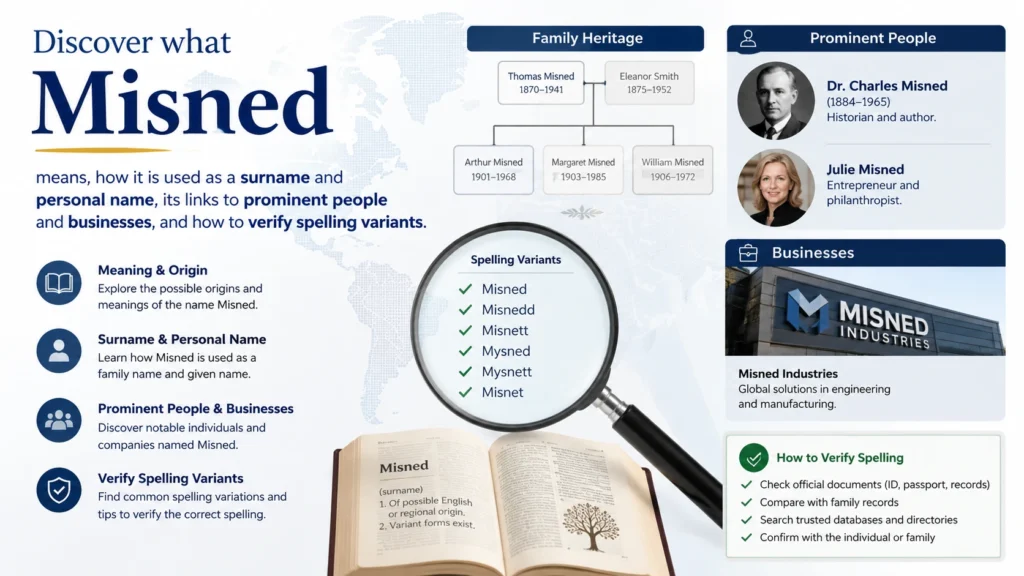
I approached the keyword “misned” with caution because it does not point to one universally accepted English definition. The available evidence shows that Misned can appear as a family name, part of the Arabic-style surname Al Misned, a business name, an online baby-name entry, or a spelling variation of Al-Misnad. It may also be entered accidentally when someone intends to search for another word. My aim in this guide is to separate what can be verified from what remains uncertain, rather than assigning the keyword a convenient but unsupported meaning.
Search results for Misned frequently lead to individuals and organizations connected with Qatar and the wider Gulf region. Official and institutional sources use several Latin-alphabet forms, including Al Misned, Al-Misned, Al Misnad, and Al-Misnad. These variations do not automatically refer to different families or meanings. In many cases, they reflect the difficulty of representing Arabic names consistently in English.
From my perspective, the most useful way to understand Misned is to treat it first as a name that requires context. A person searching for a surname may need genealogical information, while someone who saw the word on a company website may be looking for a particular organization. Another reader may simply want to know whether Misned is a correctly spelled English word. Each situation leads to a different answer.
Key Takeaways About Misned
The following points summarize the strongest conclusions supported by available sources:
- Misned is not established as a common standalone word in major English dictionaries.
- It appears most credibly as a surname or family name, often written as Al Misned or Al-Misned.
- Alternative English spellings include Al-Misnad, Al Misnad, and occasional forms such as Missned.
- Official sources associate the name with public figures, academics, business leaders, and government officials, particularly in Qatar.
- Several businesses also use Almisned or Al Misned in their names.
- Baby-name websites may describe Misned as a given name, but independent evidence for a fixed meaning or established popularity is limited.
- The term musnad exists in Arabic and Islamic scholarship, but readers should not assume automatically that musnad and Misned have the same meaning or origin.
- The intended meaning should be identified through the surrounding person, organization, country, document, or subject.
I believe the central lesson is simple: Misned should not be interpreted in isolation. The spelling alone does not provide enough information to decide whether it is a surname, business identity, personal name, transliteration, or typing error.
What Does Misned Mean?
Misned does not currently have one clear, widely documented definition as a standard English vocabulary word. When the keyword is entered into search engines, the strongest results relate to names and organizations rather than dictionary definitions. This suggests that the search term functions mainly as a proper noun.
A proper noun identifies a specific person, family, institution, company, or place. Unlike an ordinary noun, it may not carry a direct dictionary meaning that can be translated word for word. For example, a surname can have a historical origin without functioning as a descriptive word in modern usage.
This distinction matters because some websites attempt to give every name a positive or symbolic definition. A page may claim that a rare name means strength, leadership, honor, support, or wisdom, even when it provides no linguistic source. Such descriptions can be interesting, but they should not be presented as established etymology.
Based on the available evidence, I would define Misned cautiously as follows:
Misned is a rare name or surname spelling, most often encountered in forms such as Al Misned or Al-Misned, with documented use among people and organizations associated with Qatar and the Gulf region.
That definition describes how the term is used without claiming a precise origin that the evidence does not prove.
READ: Sammying in Leather Manufacturing: Process, Machines, Quality Control, and Safety
The Main Interpretations of Misned
Because the keyword has several possible uses, readers should compare the context in which they found it. This table separates the major interpretations and shows how strongly each one is supported.
Comparing the Possible Meanings of Misned
| Interpretation | What It Usually Refers To | Evidence Level | Best Verification Method |
|---|---|---|---|
| Surname or family name | A person or family using Misned, Al Misned, or a related spelling | Strong | Check official biographies, institutional pages, and original-language records |
| Personal or baby name | A rare given name listed by naming websites | Limited | Check birth records, linguistic references, and reliable name databases |
| Company or brand | Businesses using Almisned or Al Misned in their registered or trading names | Strong for specific companies | Confirm the official company website and business registry |
| Transliteration variant | An English rendering of an Arabic name also written Misnad or Al-Misnad | Strong | Compare the Arabic spelling and the individual’s preferred English form |
| Typing or spelling error | An unintended version of another word, such as minded or missed | Context-dependent | Review the sentence, keyboard pattern, and intended subject |
| Related Arabic term | Possible confusion with musnad, an established term in Islamic scholarship | Possible but unproven | Consult Arabic-language and specialist scholarly sources |
The strongest interpretation is the surname or family-name use. Company and institutional uses are also easy to verify when a specific organization is named. The baby-name interpretation is much weaker because many name-generator websites repeat claims without showing primary linguistic evidence.
Misned as a Surname and Family Name
The surname interpretation is supported by multiple official and institutional sources. Qatar Chamber identifies H.E. Eng. Ali Bin Abdullatif Al Misned as a board member and connects him with committees and business councils. Qatar Chamber reports from 2025 also identify Ali bin Abdul Latif Al Misned as a participant in regional trade and logistics activities.
Qatar University uses the spelling Al-Misnad when documenting Professor Sheikha Abdulla Al-Misnad, who served as the university’s fifth president from 2003 to 2015. The university states that she earned a doctorate in education from Durham University and played a major role in institutional reform.
The existence of both Al-Misned and Al-Misnad in official sources illustrates why researchers should not assume that one English spelling is uniquely correct. A family name originally written in Arabic may be represented differently depending on personal preference, institutional style, historical records, or the transliteration system being used.
Ancestry’s surname index also contains an entry for Misned and reports a very small presence in its indexed United States census material from 1920. That database result is useful as evidence that the exact spelling has appeared in historical records, but it is not sufficient to establish the surname’s complete origin, global population, or migration history.
In my analysis, readers researching a family connection should collect every relevant spelling. Searching only for Misned may exclude records filed under Misnad, Al-Misnad, Al Misned, or another variation.
Why Al Misned and Al-Misnad Can Appear Differently
Arabic names do not always have a single fixed English spelling. Transliteration involves representing sounds and letters from one writing system in another. The process is not identical to translation. Translation communicates meaning, while transliteration attempts to represent pronunciation or written form.
The Arabic definite article is commonly represented as “al” in English names. Depending on editorial style, it may be joined to the surname, separated by a space, or connected with a hyphen. This produces forms such as:
- Al Misned
- Al-Misned
- Almisned
- Al Misnad
- Al-Misnad
Official publications themselves can use different versions. UNESCO records, for example, include forms such as Al-Misnad and even Missned in material connected with Qatari figures. This variation demonstrates the practical inconsistency of historical transliteration, but it does not prove that every similar spelling refers to the same person or family.
Vowels are a common source of variation because Arabic and English represent them differently. The ending may consequently appear as “ned” in one source and “nad” in another. A researcher should prioritize the spelling used by the person’s current official profile while retaining alternate versions for search purposes.
A Practical Transliteration Example
Consider a hypothetical researcher looking for an academic named “A. Al Misned.” A search using only that exact spelling may return a limited group of results. Searching “A. Al-Misnad,” “Abdulla Al Misnad,” and related forms could reveal university records, publications, archived speeches, or conference programs.
This does not mean that every result belongs to the same person. It means the alternate spellings should be treated as leads that require confirmation through institutional affiliation, dates, subject area, and biographical details.
Is Misned an Arabic Word?
The evidence available in English-language sources does not justify presenting Misned as a standard Arabic word with one proven literal meaning. It may be related to an Arabic family name, but a surname’s linguistic history cannot be established merely by finding a similar dictionary word.
The Arabic term “musnad” is well established in Islamic scholarship. Oxford Reference describes the Musnad associated with Ahmad ibn Hanbal as a compilation of hadith reports organized according to the first transmitter’s name. Other references use musnad for a type of hadith collection or a report with a connected chain of transmission.
However, similarity in English spelling is not proof that Misned and musnad are interchangeable. Different vowels, transliteration choices, grammatical forms, and family-name histories can produce visually similar words.
I believe the responsible conclusion is that a possible relationship should remain a hypothesis unless an authoritative Arabic-language genealogy or linguistic source confirms it. Articles that confidently translate Misned as “support,” “authority,” “backing,” or a religious term without evidence are going beyond what the available sources establish.
Misned as a Personal or Baby Name
Some online baby-name resources list Misned as a personal name and provide material about its supposed meaning, origin, or popularity. One such result appears on Momcozy’s name-generator pages.
The presence of a name on a generator page proves only that the page contains an entry. It does not by itself prove established historical use, gender association, linguistic origin, pronunciation, or popularity. Name-generator sites often create pages at scale and may rely on automated or aggregated information.
Parents considering Misned as a given name should verify several points before relying on a symbolic description:
- Whether the name appears in official birth or population records.
- Whether native speakers recognize it as a personal name.
- Whether the spelling reflects the intended Arabic pronunciation.
- Whether the name has religious, tribal, historical, or regional associations.
- Whether the name can be registered in the relevant country.
- Whether alternative spellings would communicate the pronunciation more accurately.
A name can still be meaningful to a family even when public etymological evidence is limited. The problem arises only when uncertain claims are described as proven facts.
Hypothetical Naming Scenario
Imagine that parents encounter “Misned” in a family document and consider using it for a child. Their first step should be to speak with relatives who understand the family history and original language. The next step should be to locate the Arabic spelling.
Once they have the Arabic form, they can ask a qualified Arabic speaker or naming authority how it would normally be pronounced and transliterated. That process is far more dependable than choosing a meaning from an unsourced name-generator page.
Prominent People Associated With the Name
The name’s public visibility comes partly from individuals whose names appear in government, education, development, and business sources.
Professor Sheikha Abdulla Al-Misnad
Qatar University identifies Professor Sheikha Abdulla Al-Misnad as its fifth president, serving from 2003 to 2015. The university credits her with leadership during a major period of academic and institutional reform. It also records her work in education, research, university governance, and Qatar Foundation.
A statement published through the office of Her Highness Sheikha Moza bint Nasser provides a useful quotation from Professor Al-Misnad about the early development of Qatar Foundation:
“The QF project, with all its aspirations, was new for us, and for the world.”
Professor Sheikha Abdulla Al-Misnad, quoted by the Office of Her Highness Sheikha Moza bint Nasser
This quotation matters because it places the name in a documented account of educational and institutional development. It also shows why a search for Misned may lead readers into subjects far beyond name meanings.
H.E. Eng. Ali Bin Abdullatif Al Misned
Qatar Chamber lists H.E. Eng. Ali Bin Abdullatif Al Misned as a board member and identifies his involvement in the chamber’s Services Committee, the Qatari-Russian Business Council, and other economic bodies. Recent Qatar Chamber coverage also links him with trade, logistics, regional economic integration, and international freight-forwarding activities.
These records demonstrate that Al Misned is an actively used public surname rather than merely a historical database entry. They also highlight why the searcher’s context matters. Someone entering the keyword after reading a logistics article is probably looking for Ali Al Misned, not a baby-name meaning.
H.E. Maryam Bint Ali Bin Nasser Al Misnad
Qatar’s Ministry of Foreign Affairs identifies H.E. Mariam Al-Misnad as Minister of State for International Cooperation and summarizes her public-service background and awards. The exact spelling on official pages may vary between Mariam, Maryam, Al-Misnad, and Al Misnad in different English-language materials.
A Qatar Foundation report attributes a concise statement to her that illustrates her policy focus:
“The family is the cornerstone of our societies.”
H.E. Maryam bint Ali bin Nasser Al Misnad, quoted in Qatar Foundation’s 2024 Year in Review
The quotation is relevant because it shows how institutional sources connect the surname with social and family policy. It should not be interpreted as evidence for the surname’s linguistic meaning.
Sheikha Moza Bint Nasser
Her Highness Sheikha Moza bint Nasser is widely identified through her public work in education, health, culture, and youth development. Some official and archival records include her fuller name with the family form Al-Misnad, while her current public profiles generally use Sheikha Moza bint Nasser.
This difference is another reminder that a public figure may use a shortened professional name even when longer forms appear in historical, legal, or international records.
Companies and Organizations Using Misned
Misned and Almisned also appear in company names. These organizations should be considered separately because a shared name element does not necessarily indicate shared ownership, management, or business activity.
Al Misned International describes itself as a provider of international products and turnkey project solutions. Its LinkedIn profile categorizes the organization within international trade and development and lists a workforce range of 11 to 50 employees.
Almisned Trading presents itself as a trading-related organization offering tools, knowledge, support, products, and services. Its own website should be treated as the primary source for its stated positioning, but independent due diligence would still be necessary before entering a commercial or financial relationship.
Search results also identify contracting, joinery, holding, and other commercial entities that include Al Misned in their names. Directory listings can help locate a business, but a directory profile should not replace official registration records, licensing information, physical-address checks, or direct confirmation from the organization.
How to Distinguish Companies With Similar Names
| Check | Why It Matters | What to Confirm |
|---|---|---|
| Full legal name | Similar trading names may belong to different entities | Exact spelling, legal suffix, and registration number |
| Country and city | The same surname can be used by unrelated organizations | Registered jurisdiction and operating address |
| Industry | A trading company may be confused with a contractor or holding company | Products, services, and licensing category |
| Official domain | Copycat or outdated pages may appear in search results | Website ownership and matching contact details |
| Leadership | A shared surname does not prove common ownership | Directors, managers, and authorized representatives |
| Registry status | A website may remain online after business status changes | Current registration, renewal, and compliance status |
| Contact channels | Fraudulent profiles may imitate established names | Verified telephone numbers, emails, and office address |
The main takeaway is that “Misned company” is not specific enough for a reliable identification. The full legal name, location, and industry are necessary before drawing conclusions.
Could Misned Be a Typing Error?
Misned may also be a typing error, particularly when it appears in an ordinary English sentence rather than as a capitalized name. A typo is defined by Merriam-Webster as an error in typed or typeset material, while Cambridge describes it as a small mistake made when text is typed or printed.
The dictionary definition provides a helpful baseline:
“An error, as of spelling, in typed or typeset material.”
Merriam-Webster Dictionary
A reader should inspect the sentence to see whether another word fits better. Possible intended words might include “minded,” “missed,” “misled,” “mined,” or a proper name. The correct interpretation depends on grammar and subject.
For example, the sentence “She is environmentally misned” probably intends “environmentally minded.” In contrast, “Mr. Misned attended the meeting” likely uses a surname. Capitalization is useful but not decisive because people often write search queries entirely in lowercase.
Hypothetical Typo Examples
Typed phrase: “career misned students”
Likely intention: “career-minded students”
The suffix “-minded” describes someone inclined toward or concerned with a particular subject. Major dictionaries define minded as being inclined, disposed, or mentally oriented toward something.
Typed phrase: “Ali misned Qatar Chamber”
Likely intention: The surname Al Misned, referring to H.E. Eng. Ali Bin Abdullatif Al Misned.
Typed phrase: “misned baby meaning”
Likely intention: A search for the rare name entry or possible surname origin.
Typed phrase: “al misned international”
Likely intention: A specific business rather than a dictionary word.
These scenarios show why search intent should be inferred from neighboring words rather than the keyword alone.
How to Identify the Intended Meaning Step by Step
A structured verification process can prevent mistaken identities and unsupported name claims.
Step 1: Preserve the Original Context
Copy the complete sentence, document heading, business listing, social-media profile, or search phrase where Misned appeared. Do not begin by changing the spelling.
Context can immediately reveal whether the term is functioning as a person’s name, a business, or an adjective. A capitalized word after a first name strongly suggests a surname, while a lowercase word inside a descriptive phrase may be a typo.
Step 2: Look for the Prefix Al
Check whether the original form was Misned, Al Misned, Al-Misned, or Almisned. The presence of Al strongly supports a name or organizational interpretation.
Keep every observed form in your notes. Removing the prefix can produce broader results, but the complete form is often necessary for accurate identification.
Step 3: Identify the Country or Institution
Look for Qatar, Doha, Qatar Chamber, Qatar University, Qatar Foundation, a ministry, a company domain, or another institutional clue. These details can connect the name with an official profile.
For example, a result mentioning university reform and the years 2003 to 2015 points toward Professor Sheikha Abdulla Al-Misnad. A result about freight forwarding, trade, or Qatar Chamber may point toward Ali Al Misned.
Step 4: Search Alternative Spellings
Use quotation marks around each spelling:
- “Misned”
- “Al Misned”
- “Al-Misned”
- “Almisned”
- “Al Misnad”
- “Al-Misnad”
Add the known first name, organization, profession, or location. This produces more precise results than searching the surname alone.
Step 5: Prioritize Primary Sources
Official government pages, university records, organizational biographies, company registries, and the person’s verified website should take priority over scraped directories and automatically generated name pages.
A primary source is not infallible, but it is usually better positioned to state how an individual or organization chooses to spell its own name.
Step 6: Compare Biographical Details
Before merging two profiles, compare full names, job titles, institutions, dates, qualifications, and locations. Similar surnames do not prove that two records concern the same person.
This step is especially important when names are shortened in news articles. An article may use “Al Misned” after providing the full name only once.
Step 7: Verify the Original Script
For serious genealogical, legal, academic, or identity research, locate the name in Arabic. The original script can clarify whether two English spellings represent the same underlying name.
A qualified translator, native speaker, official record, or certified document can provide stronger evidence than search-engine similarity.
Common Mistakes When Researching Misned
One common mistake is assuming that the first baby-name result provides the authoritative meaning. These pages can be useful for inspiration, but a trustworthy etymology should identify the source language, original spelling, historical usage, and linguistic development.
Another mistake is treating every form of Al Misned or Al-Misnad as identical. Some variations may refer to the same family name, but similarity alone cannot establish identity or kinship.
Readers also sometimes confuse transliteration with misspelling. A transliteration variant may be acceptable even when it differs from another source. The preferred form is usually the one used by the person or institution concerned.
It is equally risky to infer a family relationship from a shared surname. Public figures, academics, and businesspeople using related surname forms should not be described as relatives unless a reliable source confirms the relationship.
A further mistake is translating a surname through a similar-looking Arabic or English word. This can produce a plausible story that lacks historical evidence. Etymology requires more than visual resemblance.
Finally, users may assume that a company appearing in search results is licensed, active, or trustworthy. Search visibility does not prove regulatory standing, financial condition, ownership, or service quality.
Expert Recommendations for Accurate Name Research
My first recommendation is to separate the research question into three parts: identity, spelling, and origin. Identity asks who or what the term refers to. Spelling asks which English form the person or organization uses. Origin asks about the name’s linguistic or family history. These questions require different evidence.
For identity, use current official profiles. For spelling, compare the official English form with the original Arabic. For origin, seek historical records, genealogical materials, linguistic references, and family documentation.
I also recommend recording dates. A person’s title may change, while archived articles continue to show an older role. For example, a government official may appear under a previous ministry in an older conference report. The name remains relevant, but the title must be matched to the publication date.
Researchers should distinguish between evidence and inference in their notes. “Qatar University spells the name Al-Misnad” is evidence. “Misned must therefore mean a particular Arabic word” is an inference that requires separate proof.
For business research, verify registrations directly with the relevant national authority. Check whether the company name, website, address, telephone number, and representatives match. Never transfer funds or provide sensitive documents based solely on a search result or social-media page.
For baby-name decisions, obtain the original-language spelling and ask how native speakers understand it. Consider pronunciation, cultural associations, legal registration, and whether the name is ordinarily a surname rather than a given name.
Practical Uses of the Keyword Misned
The keyword can lead to several distinct research tasks. Understanding these tasks helps writers, researchers, and ordinary readers produce more relevant results.
Genealogy and Family History
A genealogist may search Misned to locate census records, immigration files, family trees, marriage records, or regional histories. Because the exact spelling appears to be rare in some English-language databases, spelling expansion is essential.
The researcher should search both with and without Al, test Misnad and Misned endings, and review handwritten records carefully. Historical clerks often recorded unfamiliar names phonetically.
Academic Research
An academic search may involve Professor Sheikha Abdulla Al-Misnad or Fahad A. Al-Misned. King Saud University hosts a faculty profile for Fahad A. M. Al-Misned, while research databases list academic publications under closely related author forms.
Author identifiers, affiliations, research subjects, and publication dates are more reliable than surname spelling alone when distinguishing scholars.
Government and Public Policy
Readers may encounter Al-Misnad in material concerning international cooperation, education, family policy, social development, or national institutions in Qatar. Official ministry and institutional sources should be used for current appointments and policy roles.
Business Verification
A procurement officer or potential customer may search for an Al Misned organization before signing an agreement. The correct procedure is to identify the full legal entity, verify registration, examine authorized representatives, and confirm that payment details belong to that entity.
Writing and Editing
An editor may need to decide whether to standardize Al Misned as Al-Misnad. The safest editorial practice is not to impose consistency across different people. Each individual’s preferred or officially documented spelling should be preserved.
Within one article about the same person, however, the spelling should remain consistent unless the writer is discussing historical variants.
How Writers Should Use Misned in Content
Writers should capitalize Misned when it is a surname, given name, brand, or organization. The prefix should follow the person’s preferred form, including spacing or hyphenation.
At the first mention, provide the full name and role. Later references can use the surname, provided no other person with a similar name appears in the article.
A sentence such as “Al Misned said the organization supported the initiative” is acceptable after the full identity has been established. Without that earlier identification, the sentence may be unclear.
Writers should avoid claiming a specific meaning unless they can cite a reliable linguistic source. A cautious sentence would be: “Misned appears as a surname spelling, particularly in Gulf-region records.” An unsafe sentence would be: “Misned is an Arabic name that definitely means leadership,” unless authoritative evidence supports that translation.
When discussing multiple spellings, writers can say: “English-language sources render the family name in forms including Al Misned and Al-Misnad.” That wording accurately describes the evidence without declaring every form universally interchangeable.
Conclusion
I believe the clearest answer is that Misned is not one ordinary English word with a single established definition. The strongest evidence identifies it as a rare surname or name element, commonly encountered in forms such as Al Misned, Al-Misned, Al Misnad, and Al-Misnad. Official sources connect these spellings with Qatari academics, public officials, business leaders, organizations, and companies.
At the same time, the keyword can appear on baby-name pages, in business listings, or as a typing error for another word. These uses should not be merged into one unsupported explanation. A similarity to the scholarly Arabic term musnad may be worth investigating, but it should not be treated as proven etymology without stronger linguistic evidence.
My practical recommendation is to begin with context. Identify the person, institution, country, sentence, or company connected with the word. Then search alternative spellings, prioritize primary sources, and compare biographical or registration details. Anyone researching family history or a name’s origin should also obtain the original Arabic spelling.
Used carefully, the keyword misned can lead to accurate and useful information. Used without context, it can easily produce mistaken identities, unreliable meanings, and confusion between names, companies, and spelling variants.
Frequently Asked Questions
What Does Misned Mean?
Misned most commonly appears to be a rare surname or proper-name spelling rather than a standard English word with one dictionary definition. It is often found in forms such as Al Misned or Al-Misnad, particularly in sources associated with Qatar. Its precise family or linguistic origin cannot be confirmed from the spelling alone. The surrounding person, organization, country, or sentence should be examined before assigning a meaning.
Is Misned an Arabic Name?
Misned appears in English renderings of Arabic personal and family names, so it can reasonably be described as an Arabic-associated name spelling. However, that does not establish a single literal translation. Arabic names can be transliterated in several ways, and readers may encounter Misned, Misnad, Al-Misned, or Al-Misnad. The original Arabic spelling is necessary for a reliable linguistic analysis.
Is Misned a First Name or a Surname?
The strongest documented use is as a surname or family-name element, particularly in the form Al Misned or Al-Misnad. Some baby-name websites also list Misned as a given name, but independent evidence for its established use, gender, meaning, and popularity as a first name is limited. Parents should verify the original spelling and cultural use before selecting it.
Are Al Misned and Al-Misnad the Same Name?
They may be transliteration variants of the same underlying Arabic family name in some contexts, but they should not automatically be treated as identical in every case. Official sources use both forms for different people and records. Identity should be confirmed through full names, institutions, dates, roles, and the original Arabic spelling.
Is Misned Related to Musnad?
A relationship is possible, but it is not established merely by similarity in English spelling. Musnad is a recognized term in Islamic scholarship and can refer to hadith material arranged by transmitter or associated with a connected chain. Misned is more commonly encountered as a name spelling. A qualified Arabic linguistic or genealogical source would be needed to prove an etymological connection.
Could Misned Be a Misspelling of Minded?
Yes, in some sentences Misned may be a typing error for “minded.” For example, “career misned” probably intends “career-minded.” However, Misned can also be a legitimate surname or business name. Capitalization, surrounding words, location, and the subject of the text help determine the intended form.
Who Are Some People With the Al Misned Name?
Official sources identify figures including Professor Sheikha Abdulla Al-Misnad, former president of Qatar University, H.E. Eng. Ali Bin Abdullatif Al Misned of Qatar Chamber, and H.E. Mariam Al-Misnad, Qatar’s Minister of State for International Cooperation. Spellings differ across institutions, so readers should use each source’s preferred form.
Is There a Company Called Al Misned?
Several commercial names contain Misned or Almisned. Search results include Al Misned International, Almisned Trading, contracting businesses, and holding-company references. These should not be assumed to represent one organization. The full legal name, country, registration number, address, industry, and leadership should be verified before making a business decision.
How Can I Research the Misned Surname?
Start by collecting all known spellings, including Misned, Misnad, Al Misned, Al-Misned, Al Misnad, and Al-Misnad. Add first names, locations, employers, dates, and relatives to each search. Consult official records and obtain the original Arabic spelling. Historical databases can provide leads, but family relationships and origins should be confirmed through primary documents.
Which Spelling of Misned Is Correct?
The correct spelling depends on the individual, family, institution, or company. Al Misned may be correct for one person, while Al-Misnad is the official form for another. Writers should follow the spelling used by the subject’s official profile or legal documents rather than changing every name to one standardized version.
Sources and References
- Qatar Chamber profiles and reports concerning H.E. Eng. Ali Bin Abdullatif Al Misned.
- Qatar University history of Professor Sheikha Abdulla Al-Misnad’s presidency.
- Qatar Ministry of Foreign Affairs profile for H.E. Mariam Al-Misnad.
- Qatar Foundation and Office of Her Highness Sheikha Moza bint Nasser materials.
- Oxford Reference material concerning Musnad Ahmad ibn Hanbal.
- Merriam-Webster and Cambridge Dictionary definitions of typo and minded.
- Official and public-facing business sources for Al Misned International and Almisned Trading.
- Ancestry surname index entry for Misned.
Disclaimer
This article provides general informational and name-research guidance. It does not establish a person’s identity, family relationship, tribal affiliation, legal name, company ownership, or verified genealogy. English spellings of Arabic names can vary, and current titles or company details may change. Readers should consult original-language records, official government or institutional sources, certified documents, qualified translators, genealogists, or legal and regulatory authorities when accuracy has personal, legal, financial, or commercial consequences.