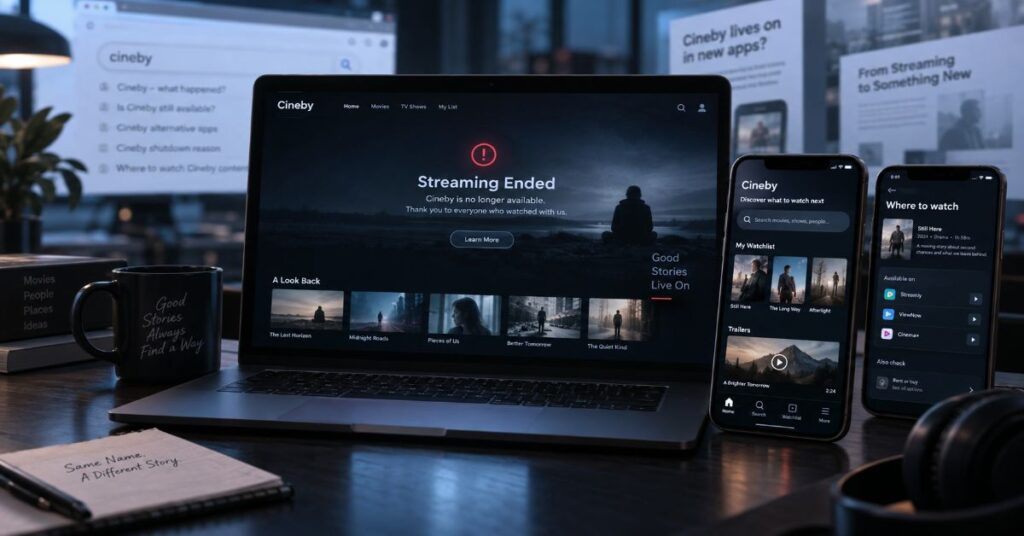
Cineby is no longer the streaming service many searchers remember. Its team shut off film and series streaming on August 31, 2026, and said the remaining domains would disappear after September 5. Yet the name did not disappear from search. It now leads to sites that claim a link to the old team, mobile apps built for title search, and at least one app listing that clearly says it is not connected to the old service. That split is the key fact for anyone searching the brand today. The old question — “does the site work?” — is now too narrow. A page can load and still have no proven link to the former team. A mobile app can carry the same name and offer trailers, watchlists, or “where to watch” data without recreating the old streaming service. A guide written before late August can also look current while describing a service that has already closed. Our review checks ownership, status, licensing, and device safety one by one. The same verification problem appears in our NFLBite 2026 guide, where a known streaming label can survive across several domains without proving who controls them. Here, the post-shutdown name problem is even sharper because the former team warned users that no official replacement existed. This guide follows that proof trail instead of sending readers toward a new mirror.
The Old Service Is Gone, but the Name Is Not
The cleanest way to understand the current search landscape is to separate three things that share one label. First is the old browser-based streaming service recorded by anti-piracy reporting and the Motion Picture Association. Second are post-shutdown sites that use known branding or claim to be a successor. Third are current app-store products that use the same or a similar name for entertainment search.
That distinction matters because the former team’s final statement, reproduced by TorrentFreak on August 31, said there was no official replacement and warned that sites claiming to be one were copycats (Van der Sar, 2026b). This does not prove every later page is malicious. It does mean that a logo, color scheme, known interface, or matching keyword is not proof that the same team runs it.
The Cineby app-store record makes the name problem unusually clear. A Google Play listing by Praveen Kumar Gupta, updated June 4, 2026, says the app does not host or stream content. It helps users find where titles are legally available. A separate Google Play listing from NET VISOR LLP, updated September 9, says its movie-finder app is not linked to the old service. Apple’s App Store also lists a product by Prashanth Hegde focused on search, watchlists, trailers, and official streaming access. These are not the same product as the former browser streaming network (Google Play, 2026a, 2026b; Apple, 2026).
What a Current Search Result Can Actually Mean
| Result type | Current evidence | What it does not prove | Reader takeaway |
| Original streaming operation | Staged shutdown completed in late Aug./early Sept. 2026. | That any new domain using the label is the same operator. | Treat the old network as closed unless new provenance is independently verified. |
| Post-shutdown website claiming continuity | May use familiar branding, layout, or “official” language. | Ownership, licensing, security, or continuity. | Require a verifiable link to a pre-shutdown operator channel. |
| Google Play discovery app | One listing says it does not host or stream content. | Connection to the former browser streaming network. | Judge the app as a discovery tool and verify the developer. |
| Google Play independent app | A Sept. 9 listing explicitly says it is not associated with the original. | Any inherited rights, accounts, or infrastructure. | Do not infer affiliation from the shared keyword. |
| Apple App Store discovery app | Offers watchlists, trailers, title data, and service discovery. | That it reproduces the former site’s free-streaming model. | Read the listing and privacy disclosures before assuming functionality. |
What Actually Happened: The Shutdown Timeline
The closure did not happen in a single switch-off. On August 26, TorrentFreak said a staged schedule covering mirror redirects, anime and sports streams, downloads, accounts, and finally films and series. The August 31 update confirmed that streaming had been turned off as planned and said everything remaining would be switched off after September 5 (Van der Sar, 2026b).
This timeline matters for search accuracy. A page published on August 20 could truthfully describe a working service and still be obsolete less than two weeks later. That is why status guides need a date, a source trail, and a distinction between the last checked owner notice and whatever domains happen to rank today.
| Date | Documented step | Why it matters |
| August 25, 2026 | Mirror brands Fmovies+ and Cineplay began redirecting, according to the staged schedule. | The wind-down was operational, not just a notice banner. |
| August 26 | Anime and sports streams were scheduled to switch off. | Different content systems disappeared at different times. |
| August 27 | Downloads were scheduled to stop. | A working page did not mean every feature still worked. |
| August 28 | Account system was scheduled to go down and accounts to be deleted. | Old credentials should not be entered into a later unverified “successor.” |
| August 30–31 | Final viewing window ended; film and series streaming was switched off on August 31. | This is the key break point for articles still describing an active service. |
| September 5 | Operators said every remaining domain would be gone after this date. | Later pages using the name need fresh ownership evidence. |
Why the Shutdown Story Is More Nuanced Than “Legal Pressure”
There was substantial copyright pressure around the service, but the public record does not support one confirmed cause for the shutdown. In its 2025 notorious-markets submission, the Motion Picture Association described the service as a fast-growing piracy site in the “hydra site” category. It listed 68.8 million monthly visits in August 2025, citing Similarweb. The filing also said the service relied on third-party video systems for on-demand content and live sports (Motion Picture Association, 2025).
By August 17, 2026, TorrentFreak said more than 160 million estimated visits in the previous month and noted that the site had been blocked by court order in several countries (Van der Sar, 2026a). Those facts establish legal and industry pressure. They do not, by themselves, prove that a particular lawsuit, seizure, or rights-holder agreement caused the August shutdown.
The team’s later explanation pointed elsewhere. It said two main video providers had gone down roughly three months earlier and the service never returned to the stability it wanted (Van der Sar, 2026b). Both facts matter: legal pressure existed, while the team publicly blamed failed video systems and poor reliability for its final choice. Pages that state a single cause as settled fact go beyond the strongest available proof.
The Search-Result Identity Problem After September 5
A shutdown can remove a service without removing demand for its name. Search demand still has value, so other publishers, app makers, mirrors, and guide sites can compete for the same query. The brand gains a “name afterlife”: the keyword survives after the known owner has left.
This is where freshness and provenance matter more than surface design. Before trusting a page, ask what proof connects it to the former owner. Was the domain announced before closure? Did a pre-shutdown channel point to it? Does the app maker match anything in the old record? If not, call it “a current site or app using the name,” not “the official new home.”
Our MyReadingManga verification guide uses the same proof-first rule. A claim does not become true just because many blogs repeat it. Here, the key claim to resist is that the first new domain in search must be the official successor.
Safety: Verify the Destination, Not Just the Brand
No responsible review can declare every current lookalike page infected, and this research did not run a live malware audit of every domain using the name. The safer conclusion is behavioral. After a high-profile service closes, a known brand is easier to imitate. Visual similarity alone gives users little reason to trust a new page.
Treat unexpected APK downloads, browser-extension prompts, alert requests, fake codec or player installs, and requests for old logins as warning signs. If a page asks you to weaken device protections just to watch a title, demand stronger proof. App stores add useful signals such as a maker name, update history, privacy details, and a stable listing. Even so, an app-store presence does not prove a link to the old streaming service.
Device rules also differ. Android generally allows broader sideloading, while Apple’s alternate app distribution rules depend on region. Our iPhone vs Android comparison explains why app sources and sideloading are platform-level differences, not one universal phone-safety story. One system does not make every download safe. The source of an install and the access it requests both matter.
The useful rule is simple: verify the maker and delivery channel before installing anything, and do not reuse passwords from a defunct service on an unchecked successor. If you only want title search, trailers, or a watchlist, a search app should be judged on those functions rather than assumed to recreate an old streaming network.
Legal Status: Separate Rights, Owner Claims, and Viewer Rules
The rights question should be kept apart from the ownership question. The Motion Picture Association’s filing characterized Cineby as a piracy service carrying premium films, sports, local content, and anime outside the normal subscription model (Motion Picture Association, 2025). That is a rights-holder industry submission, not a criminal judgment against every person who visited the site.
Viewer exposure can vary by country and by conduct. Streaming, downloading, uploading, redistributing, running a service, and selling access are not legally identical acts. A global guide should not claim that every viewer everywhere commits the same offense. Readers with a specific legal concern should check local copyright law or seek qualified legal advice.
For everyday use, there is a simpler consumer test: can the service show licensed streaming rights or point you to the actual rights holder? A polished interface is not a license. An old domain is not a license. Saying that content is “hosted elsewhere” does not settle the rights question either.
Replacing the Useful Parts Without Recreating the Risk
The old service bundled several jobs together: finding a title, remembering what to watch, tracking episodes, and playing video. Many search results treat “replacement” as another free streaming mirror. That is only one interpretation of what users need.
For title search, use a current movie database, a licensed streamer’s browse tools, or an app that clearly describes itself as a search product. For “where can I watch this?” queries, prefer official title pages or legal “where to watch” tools that route to licensed services in your region. For watchlists, favor a platform with account recovery and clear privacy controls. For viewing, follow the current rights holder rather than a reused brand name.
FilmyZilla2023’s Substance Movie explainer shows the information side of movie search. Readers can research a film’s plot, cast, awards, or ending without confusing a guide with a streaming service. The same split helps here: finding content and playing content are different jobs.
This function-by-function approach is less flashy than a list of ten unofficial mirrors, but it lasts longer. If one legal catalog changes, you update the access check. You do not have to guess whether a new lookalike inherited the owners, video systems, or risk profile of a service that clearly said it was ending.
A Better Decision Framework for Any “Working” Result
- Ownership: Who publishes this page or app, and can it be linked to a known pre-shutdown channel?
- Function: Is it a streaming service, a search tool, a watchlist app, a guide page, or a “where to watch” tool? Do not infer the function from the keyword alone.
- Rights: Does the service name licensed sources, or does it simply promise premium content without explaining the rights?
- Delivery: Is software supplied through a recognized store, a verified maker site, or an unknown APK download?
- Access and logins: Does the product ask for access that seems excessive for its stated job, or request passwords tied to the old service?
- Freshness: Was the page updated after August 31 and September 5, 2026, or is it recycling pre-shutdown language?
This six-part check is more useful than a binary “safe/unsafe” label because it shows what is known and what is not. It also ages well. If a new app or domain appears tomorrow, the same questions still apply.
The Future of Cineby in 2027
The most defensible 2027 forecast is about the keyword, not a promised comeback. Search demand can outlive an owner. Current results already show the name on search apps and on sites with no proven link to the old team. Brand fragmentation may therefore continue even if the old systems never return.
A genuine comeback would need stronger proof than a known domain or copied design. Useful proof could include control of a channel verified before shutdown or another clear chain of provenance. As of September 19, 2026, the final statement reported by TorrentFreak said there was no official replacement and warned against claims of team affiliation (Van der Sar, 2026b).
A second trend is the split between entertainment search and streaming. Current app-store listings already use the name for watchlists, trailers, search, and legitimate “where to watch” features. By 2027, the better question may be: “Which product am I looking at, who publishes it, and what does it actually do?”
Key Takeaways
- The old streaming network is closed; post-September results should not be treated as continuations without independent proof.
- The strongest under-covered search issue in late 2026 is name confusion: the same keyword now points to different product types.
- The MPA recorded large-scale alleged infringement and traffic, while the team later cited failed video providers and poor stability as its reason for leaving.
- App-store listings using the same name can be lawful search products while still being unrelated to the former streaming service.
- A safety claim should match the proof. Unknown downloads, extensions, redirects, access requests, and reused logins are useful warning signs; a current malware verdict needs current technical proof.
- Replacing search, watchlists, “where to watch” checks, and viewing with separate licensed tools is more robust than chasing an unchecked mirror.
Conclusion
The keyword now describes a search problem as much as a streaming brand. The old service grew large enough to draw industry scrutiny, then ended through a staged shutdown. What remains in search is a mix: app-store products with different makers and functions, sites that may claim a link to the old team, stale articles, and newer explainers trying to map the gap.
That is why the strongest 2026 answer is not a mirror list. It is a provenance test. Separate the former team from anyone now reusing the name. Separate search apps from streaming services. Separate copyright context from claims about one user’s legal exposure. Then check the maker, delivery channel, requested access, and rights path before you install, sign in, or pay. This takes more work than trusting the first familiar-looking page, but it fits the post-shutdown record and stays useful as search results change.
Frequently Asked Questions
Is Cineby still working in 2026?
The old streaming service is not. Its team said film and series streaming stopped on August 31, 2026, with remaining domains set to disappear after September 5. Pages or apps using the same name can still appear, but they should not be assumed to belong to the former team without independent proof.
Why did the old streaming service shut down?
The final statement reported by TorrentFreak said two major video providers had gone down about three months earlier and the service never fully stabilized. Copyright pressure and blocking were part of the wider context, but the available proof does not establish one enforcement action as the confirmed direct cause.
Is there an official replacement or new domain?
The former team’s final public statement said there was no official replacement and warned about copycats. A later site can still use the same branding, but that alone is not proof that the same team runs it. Look for proof tied to a channel controlled before the shutdown.
Why are there mobile apps with the same name?
The name is being used by several app makers. Current Google Play and Apple listings describe search, watchlist, trailer, and “where to watch” features; one Google Play listing clearly says it is not related to the old service. Check the maker and listing details rather than relying on the app name.
Is every current lookalike site dangerous?
That cannot be established from the brand name alone. This review did not run a technical malware audit of every current domain. Treat unexpected APK files, extension installs, alert prompts, repeated redirects, login requests, and payment forms on unverified sites as warning signs.
Was the former service legal?
The Motion Picture Association classified the former service as a piracy site and alleged large-scale access to premium copyrighted content. Legal consequences differ by jurisdiction and conduct, so a global guide should not treat operators, uploaders, downloaders, and passive viewers as legally identical.
What should I use if I only want to find where a movie is available?
Use an official title page, a licensed streaming service, or a reputable “where to watch” tool that points to authorized providers in your region. Finding a title does not require trusting a post-shutdown mirror or installing an unknown streaming APK.
Methodology
Our desk reviewed a live September 19, 2026 search snapshot and compared 10 prominent explanatory results: TechTryHub, AlternativeTo, CinebyPro, CinebyHD, Natchecker, Cinedock, a Cineby-alternative comparison site, an APK-focused alternatives guide, a current branded explainer, and TorrentFreak. Search order varies by country, device, personalization, and time, so this is a SERP benchmark rather than one universal ranking.
Competitors repeatedly covered features, safety or legality, troubleshooting, and alternatives. The under-covered issues were post-shutdown freshness, original-versus-copycat identity, unrelated app listings, and shutdown causation. We built the structure independently around those gaps.
Claims were checked against the Motion Picture Association’s 2025 submission, current Google Play and Apple App Store listings, and dated TorrentFreak reporting that preserved the operator notices. The MPA is a rights-holder industry body, so its piracy classification is attributed rather than treated as a court judgment.
This article was drafted with AI assistance and reviewed by the FilmyZilla2023 Editorial Team. All data, citations, and claims have been independently verified against primary sources.
References
- Apple. (2026). Cineby – TV Shows & Movies [App Store listing].
- Google Play. (2026a, June 4). Cineby [App listing by Praveen Kumar Gupta].
- Google Play. (2026b, September 9). Cineby [App listing by NET VISOR LLP].
- Motion Picture Association. (2025). MPA Notorious Markets 2025 Submission.
- Van der Sar, E. (2026a, August 17). Pirate streaming giant Cineby announces surprise shutdown. TorrentFreak.
- Van der Sar, E. (2026b, August 26; updated August 31). Cineby starts staged shutdown of its piracy empire. TorrentFreak.