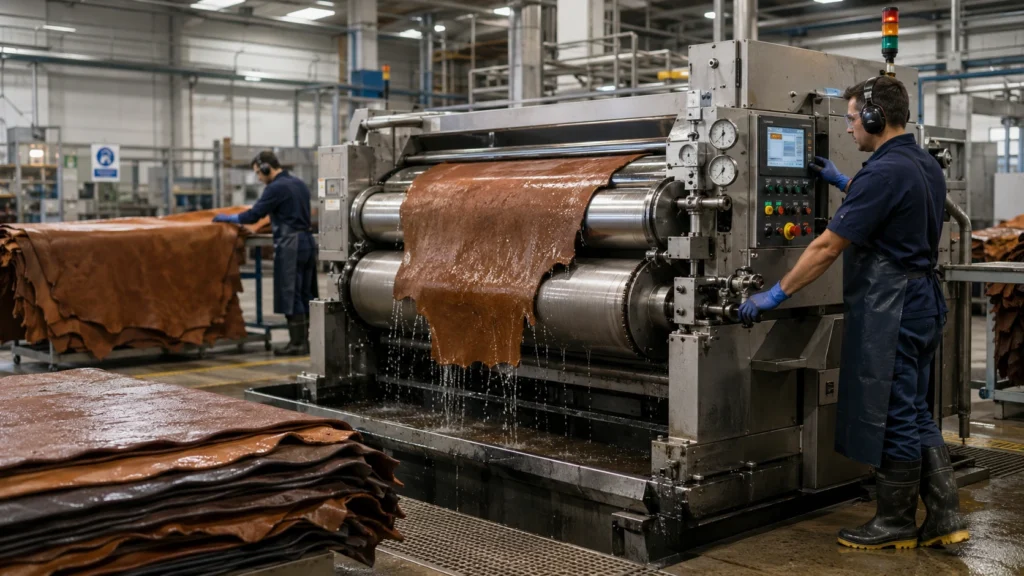
I see sammying as one of those leather-manufacturing operations that looks straightforward from a distance but becomes much more important once we examine its effect on consistency, productivity, thickness control, and subsequent processing. A machine applies pressure to wet leather, removes surplus water, and delivers material that is easier to split, shave, set out, dry, or process further. Yet the quality of the result depends on far more than simply applying the greatest possible pressure.
In my analysis, effective sammying requires a controlled relationship between the incoming leather, machine pressure, transport speed, felt condition, spreading action, operator technique, and the requirements of the next production stage. When those variables are balanced, the operation can produce more uniform moisture distribution, reduce wrinkles, improve handling, and support stable downstream results. When they are not balanced, a tannery may encounter creases, uneven water removal, grain damage, poor stretching, inconsistent thickness, or avoidable machine downtime.
This guide explains the meaning of sammying, its position in leather production, how the machinery works, which controls matter, what problems operators commonly encounter, and how managers can approach process improvement without treating every hide or production article in the same way.
Key Takeaways
- Sammying is a mechanical operation used to remove excess moisture from tanned hides or skins, particularly wet blue and wet white leather.
- The process normally takes place after tanning and before operations that require more stable moisture conditions, such as splitting, shaving, setting out, post-tanning work, or drying.
- Pressure is important, but pressure alone does not determine quality. Feed speed, hide placement, felt performance, spreading action, machine alignment, and incoming moisture also matter.
- Sammying is not the same as final drying. It removes free or surplus water and prepares leather for subsequent processing.
- Different leathers may require different operating settings because thickness, tannage, size, structure, moisture content, and intended end use can vary.
- Guards, emergency stops, electrical protection, hydraulic maintenance, safe feeding procedures, and lockout practices are essential around high-pressure sammying equipment.
- Reliable production control depends on recording settings and evaluating the discharged leather rather than relying only on the machine’s displayed pressure.
What Sammying Means in Leather Processing
Sammying is the mechanical removal of excess water from tanned leather. The leather is passed through or pressed between machine components that exert controlled force. Felts and rollers help carry the hide, absorb or channel displaced water, and maintain movement through the machine. Depending on the equipment, a spreading cylinder or related mechanism may also help open the hide and reduce folds before or during pressing.
The OECD provides a particularly direct definition:
“Sammying: Removing excess moisture from the wet blue.”
OECD, Emission Scenario Document on Leather Processing Industry
That definition is brief, but it identifies the central function accurately. Wet blue is the chrome-tanned intermediate material named for its characteristic blue appearance. The FAO describes wet blue as chrome-tanned hide and explains that surplus water is removed before drying to make the hides suitable for operations such as splitting and shaving.
Sammying generally follows tanning, although the exact process position can vary according to a tannery’s production route. The OECD describes tanning as being followed by draining, sammying, or shaving to reduce moisture before further mechanical operations. This means sammying should not be viewed as an isolated activity. It is a preparation stage whose success is partly measured by how effectively the next operation can be performed.
The term can also appear in connection with wet white leather and with combined sammying and setting-out machinery used later in production. Equipment manufacturers distinguish between machines designed primarily for wet blue and machines that combine moisture removal with stronger stretching or setting-out action.
Sammying Is Not the Same as Final Drying
One of the most common misconceptions is that sammying dries leather to its final moisture level. It does not. The operation mechanically expels surplus water, but additional drying is normally required.
Leather Naturally explains that leather leaving wet-end processing may carry almost its own weight in water. It then has to be brought down to the moisture level required for crust or finished leather through setting out and subsequent drying methods such as air, toggling, vacuum, tunnel, or low-temperature drying.
The distinction matters because sammying and thermal or vacuum drying affect leather differently. Sammying relies principally on pressure and transport through a mechanical system. Final drying removes more deeply retained moisture and has a major influence on handle, area, softness, shape, and dimensional stability.
Sammying and Setting Out Are Related but Distinct
Sammying focuses primarily on water removal. Setting out combines water removal with a more deliberate effort to flatten, stretch, and open the leather. In practice, the boundary can become less obvious because modern machines may perform both functions.
A wet blue sammying machine may include a spreading cylinder that improves leather presentation before pressing. A combined sammying and setting-out machine can use coordinated stretching cylinders, independent thickness adjustments, and controlled transport to produce a stronger setting-out effect.
I believe the most useful way to distinguish the terms is by looking at the principal production objective. When the main objective is to expel water and condition wet blue for splitting or shaving, the operation is generally described as sammying. When the process is expected to remove water while substantially stretching and flattening leather before final drying, setting out becomes a more prominent part of the description.
Why Sammying Matters to Leather Quality
The immediate purpose of sammying is moisture removal, but its influence extends into several later stages. Moisture affects leather’s compressibility, flexibility, feeding behavior, weight, and response to cutting or pressure. If water remains unevenly distributed, the leather may react inconsistently across its surface.
The sammying process applies strong pressure to wet hides, which removes excess water from the fibre structure. Industry equipment sources also associate proper sammying with smoother presentation, fewer creases, and preparation for later tannery operations.
It Supports More Consistent Splitting and Shaving
Splitting separates leather horizontally into layers, while shaving removes material to achieve a more precise thickness. Both operations depend on controlled feeding and predictable material behavior.
Leather that contains pockets of excessive water may compress differently as it reaches a blade or feed roller. One area may flatten more than another, making thickness control less stable. Proper sammying does not eliminate every source of variation, but it gives the splitting or shaving process a more consistent starting condition.
Consider a hypothetical example involving a batch of heavy bovine wet blue. Several hides leave the tanning drum with folds and visibly different surface wetness. If they are sent directly to shaving, the operator may struggle to maintain uniform feeding and thickness. Sammying the batch under validated settings can remove surplus water and open the hides, making the shaving stage more manageable. This is an illustrative scenario, not a documented production result.
It Reduces Folds and Improves Presentation
A hide that enters a pressure zone with a folded edge can leave with a deeply compressed crease. Correct placement and spreading therefore matter as much as the nominal machine setting.
GER Elettronica describes sammying as contributing to a smooth, uniform surface and reducing creases or imperfections. The company also highlights the value of collecting measurements such as size, thickness, weight, and selection data during this phase.
From my perspective, this illustrates an important operational principle: sammying should not be evaluated only by the amount of water observed at the machine. The appearance and condition of the discharged hide are equally important.
It Can Stabilize Downstream Production
Removing water mechanically before later drying can reduce the quantity of moisture that subsequent equipment must handle. It can also make the material lighter and less difficult to move between operations.
The exact productivity benefit depends on the tannery’s process route, equipment, leather type, and target moisture. It would therefore be misleading to promise a universal percentage improvement. We can reasonably conclude, however, that consistent mechanical dewatering gives downstream operations a more controlled and repeatable input.
How a Sammying Machine Works
A sammying machine processes leather through a sequence of feeding, spreading, pressing, moisture displacement, and discharge. Individual designs vary, but continuous hydraulic machines commonly use transport systems, felts, pressing cylinders, hydraulic pressure, and automatic felt-centering mechanisms.
Feeding and Hide Presentation
The operator or automated feeding system places the wet hide on the entry table or conveyor. The hide should be opened as fully as possible, with folded edges, doubled sections, and severe wrinkles corrected before the material reaches the pressure zone.
This preparation is not cosmetic. A doubled area is effectively thicker than the surrounding hide. When it passes through a narrow, high-pressure zone, it may receive excessive localized compression or create unstable feeding.
The operator must also maintain a safe distance from nip and crushing points. Production speed must never encourage workers to push, pull, or reposition leather inside an active danger zone.
Spreading and Transport
Modern through-feed machines may use a spreading cylinder or coordinated stretching system to open the leather as it travels. Escomar describes a wet blue sammying machine with a spreading cylinder designed to optimize stretching, hydraulic transfer with variable speed, and automatic felt centering.
The transport system determines how long each part of the hide remains within the working zones. A slower speed may increase dwell time, while a higher speed can increase throughput. The relationship is not always linear because the machine’s pressure distribution, felt condition, leather thickness, and number of pressing points also influence the result.
Pressing and Water Removal
The pressing section applies force to the leather. Pressure compresses the wet fibre structure and forces out surplus water. Felts help carry the leather while accepting moisture and distributing pressure.
Published machine capacities vary considerably. GER Elettronica notes that sammying presses may work at forces up to 80 tons, while particular large continuous machines advertised by Escomar list substantially higher total hydraulic forces. These are model-specific figures, not standard settings that should be applied to every process.
Higher available machine force does not mean every leather should be processed at maximum pressure. Excessive compression may mark the grain, create harsh areas, exaggerate folded sections, overload components, or produce an unsuitable result for the next operation.
Felt Operation
Felts serve several purposes. They transport the leather, absorb or carry displaced moisture, help distribute force, and provide a working interface between the leather and machine components.
A felt that is contaminated, glazed, unevenly worn, poorly tensioned, or tracking incorrectly can affect the entire result. Symptoms may include stripes, moisture differences, slippage, poor feeding, repeated stoppages, edge damage, or inconsistent pressure marks.
Automatic felt-centering systems can assist with tracking, but they do not remove the need for inspection. Operators and maintenance personnel should check felt condition according to the manufacturer’s procedure and the tannery’s preventive-maintenance schedule.
Discharge and Evaluation
The discharged leather should be inspected before the next hide is used to confirm a new setting. The operator can look for:
- Remaining folds or wrinkles
- Uneven surface wetness
- Excessively wet neck, belly, or edge areas
- Grain marks
- Poor spreading
- Edge curling
- Transport marks
- Unusual stretching
- Slippage or misfeeding
I recommend treating the first hides from every significantly changed batch as verification pieces. A setting that performs well on light calf leather may not be suitable for heavy bovine sides, thick vegetable-tanned leather, splits, or smaller skins.
Main Types of Sammying Equipment
The following comparison shows how common machine categories differ in purpose. Actual designs and capabilities vary by manufacturer, model, working width, pressure system, and automation package.
| Equipment type | Main purpose | Typical characteristics | Suitable production context | Main control concerns |
|---|---|---|---|---|
| Continuous wet blue sammying machine | Remove surplus water from tanned hides before further mechanical work | Through-feed transport, hydraulic pressure, felts, spreading cylinder, variable speed | Medium or high-volume wet blue production | Pressure, speed, felt tracking, hide presentation |
| Hydraulic or pneumatic press-type machine | Mechanically press water from hides or skins | Batch or semi-continuous pressing, strong localized force | Specialized production or installations using press-based workflows | Load placement, pressure distribution, cycle time |
| Combined sammying and setting-out machine | Remove moisture while producing stronger flattening and stretching | Pressing, multiple stretching cylinders, independent adjustments, touch-screen controls on some models | Leather processed after dyeing or before vacuum drying | Thickness adjustment, stretching speed, pressure, transport synchronization |
| High-capacity multi-pressure machine | Increase throughput and distribute pressure across several working points | Multiple pressure bridges or cylinders, higher installed force, faster transport | Large whole hides and high-output industrial lines | Feed consistency, safety systems, felt wear, maintenance load |
| Instrumented or digitally monitored line | Combine moisture-removal work with production data collection | Area, thickness, weight, selection, traceability, or process measurements | Tanneries seeking stronger batch control and traceability | Calibration, data accuracy, recipe management, operator training |
The table reflects features described by tannery-technology and machine suppliers, including hydraulic transport, automatic felt centering, stretching cylinders, multiple pressure points, and integrated measurement systems. The exact combination is equipment-specific.
The central takeaway is that equipment selection should follow the leather article and production objective. A tannery that mainly processes wet blue for shaving has different needs from one that wants a combined setting-out result before vacuum drying.
Practical Applications of Sammying
Sammying can serve several production routes, but the settings and quality criteria should be adjusted for each application.
Wet Blue Before Splitting or Shaving
This is the clearest application. Wet blue contains substantial moisture after chrome tanning. Surplus water is removed so the material can be handled and mechanically processed more consistently. The FAO specifically places surplus-water removal before splitting, shaving, and drying in its description of wet blue processing.
For wet blue, the tannery may focus on moisture uniformity, wrinkle removal, clean feeding, and preparation for thickness control. Grain protection is also important because damage introduced at this stage may remain visible in the final leather.
Wet White Leather
Wet white is tanned without the conventional chromium system that gives wet blue its color. It can still require mechanical dewatering before splitting, shaving, post-tanning, or storage.
Operators should not assume that a wet blue recipe transfers directly to wet white. Differences in tannage, fibre response, thickness, and customer requirements may justify different pressure and speed settings.
Leather After Dyeing or Wet-End Processing
Combined sammying and setting-out machines can be positioned after dyeing and before vacuum drying. In this context, the machine is expected not only to remove water but also to stretch and flatten the leather. Escomar describes this application for its combined through-feed equipment.
At this stage, area yield, shape, grain appearance, and drying preparation may receive greater attention than they do during basic wet blue sammying.
Leather Naturally emphasizes the importance of drying in the overall production process:
“Drying is one of the most important physical steps in leather production.”
Leather Naturally, Modern Cow Leather Processing
The quotation helps explain why moisture-removal operations before drying deserve careful control. They establish the physical condition in which leather enters a stage that can strongly affect its final character.
Heavy Leather, Splits, Sides, and Small Skins
Different shapes and structures create different handling challenges. Whole bovine hides require sufficient working width and careful spreading. Sides may feed more easily but can still have irregular neck and belly areas. Splits may stretch or distort differently from grain leather. Sheep and goat skins may require gentler handling because of their size, substance, or structure.
A practical production recipe should therefore identify at least the leather type, tannage, thickness range, size category, incoming condition, target outcome, and next process. “Wet leather” is too broad a classification for reliable machine setup.
Step-by-Step Sammying Procedure
The following sequence is a general operational framework. It does not replace the machine manufacturer’s manual, workplace risk assessment, authorized training, or local safety requirements.
1. Confirm the Production Specification
Before starting, identify the article, hide type, tannage, thickness range, batch number, expected input condition, and next operation. Review the approved process recipe rather than relying on memory.
The specification should explain what an acceptable discharged hide looks like. A vague instruction such as “remove enough water” is difficult to verify. A stronger instruction may include an approved pressure range, speed range, visual criteria, permitted moisture variation, and inspection frequency.
2. Inspect the Machine and Work Area
Check guards, emergency stops, interlocks, entry and exit zones, hydraulic components, visible electrical installations, felts, rollers, conveyors, and housekeeping conditions.
Water on the floor increases slip risk. Water near switches, damaged cables, or unprotected electrical components creates a more serious hazard. Unusual leaks, sounds, vibration, felt movement, or warning indicators should be reported before production begins.
3. Verify Felt Condition and Tracking
Inspect the felts for contamination, glazing, tears, edge damage, uneven wear, incorrect tension, and tracking problems. Confirm that centering devices are functioning.
A felt problem can imitate a pressure problem. For example, a tannery may increase hydraulic force because leather remains wetter on one side, when the actual cause is poor felt condition or uneven contact.
4. Load the Approved Machine Recipe
Select the correct pressure, speed, gap, stretching action, and associated settings for the batch. Where computerized controls are available, confirm that the recipe name matches the production order.
Machine settings should be treated as a coordinated package. Adjusting one variable can change the effect of another. Increasing speed while holding pressure constant may alter water removal, while increasing pressure without correcting poor spreading may deepen wrinkles.
5. Prepare the First Hide
Open the hide on the feed table and remove severe folds. Present it in the orientation specified by the standard operating procedure.
The operator should never place hands beyond designated safe feeding limits. Sticks, hooks, or other feeding aids should be used only when they are approved by the manufacturer and the tannery’s safety procedure.
6. Feed the Hide Smoothly
Feed the hide centrally and evenly. Avoid sudden pulling, bunching, overlapping, and diagonal entry unless the machine procedure specifically requires a controlled orientation.
For continuous equipment, the operator should allow the transport and spreading systems to take the material. Attempting to force or restrain a hide after it has entered the working zone can expose the operator to crushing and entanglement hazards.
7. Observe Machine Behavior
Watch for felt drift, unstable feeding, unusual pressure response, hydraulic noise, vibration, leather slippage, folded edges, and delayed discharge.
An operator should stop the process through the approved control if the hide jams or feeds incorrectly. Reaching into an active machine is never an acceptable correction method.
8. Inspect the Discharged Hide
Check moisture uniformity, surface appearance, grain condition, edges, stretching, remaining folds, and suitability for the next stage.
Where measurement systems are available, record relevant data such as area, thickness, weight, or production classification. GER Elettronica identifies these as useful data points for quality and process consistency during sammying.
9. Fine-Tune One Variable at a Time
When improvement is needed, change one principal variable within the approved range, process another verification hide, and compare the result.
Changing pressure, speed, gap, and spreading action simultaneously makes it difficult to identify the cause of improvement or deterioration. Controlled adjustment produces better process knowledge.
10. Record and Release the Batch
Once the result meets the specification, record the approved settings and begin regular production. Continue periodic inspections because incoming hides, felt moisture, temperature, wear, and machine behavior can change during the shift.
Sort or isolate nonconforming leather instead of sending it silently to the next operation. Early segregation prevents one process problem from becoming a larger batch-quality issue.
Process Variables That Influence Sammying Results
Sammying quality is produced by interacting variables. I believe this is the most important concept for process improvement because it prevents teams from treating pressure as the only meaningful control.
Incoming Moisture
Two hides from the same batch can reach the machine with different quantities or distributions of surface water. Drain time, piling, transport delay, folds, and batch handling can all influence the starting condition.
A stable draining and staging procedure can therefore improve sammying consistency before an operator changes the machine.
Leather Thickness and Structure
Thicker material generally behaves differently from thin material under pressure. Looser structural areas, such as bellies, may compress or stretch differently from compact butt areas. Splits also react differently from grain leather.
Settings should accommodate the most sensitive parts of the hide, not merely the average thickness.
Hydraulic Pressure
Pressure determines the force applied in the working zone. Too little pressure may leave excessive water. Too much may create grain impressions, harsh compression, excessive stretching, or mechanical stress.
Published machine capacities represent engineering capability. They are not universal production recommendations.
Transport Speed
Transport speed affects throughput and the time available for spreading and pressing. A fast setting may work well for uniform, lighter material but produce inconsistent results on thicker or poorly opened hides.
Speed should also reflect how safely operators can present the leather. A production target that encourages rushed feeding is poorly designed.
Felt Condition
Felts directly influence contact, transport, water handling, and pressure distribution. Their condition should be part of every troubleshooting investigation involving uneven moisture or feeding.
Hide Placement
A technically correct machine setting can still produce poor leather when the hide enters folded or off-center. Good operator technique remains important even on highly automated equipment.
Machine Alignment and Maintenance
Rollers, bearings, hydraulic components, sensors, centering devices, guards, conveyors, and controls must work as designed. Gradual deterioration can lead operators to compensate with settings, masking the underlying mechanical fault.
Sammying Problems, Causes, and Corrective Actions
This table connects visible defects with possible causes. It should be used as a diagnostic starting point, not as a substitute for technical inspection.
| Observed problem | Possible causes | Practical checks | Potential response |
|---|---|---|---|
| Leather remains excessively wet | Low pressure, excessive speed, saturated or glazed felts, poor contact, very high incoming water | Compare both sides, inspect felts, verify hydraulic reading, review drain time | Correct felt issue, reduce speed or adjust pressure within approved limits |
| One side is wetter than the other | Felt tracking problem, uneven pressure, off-center feeding, roller misalignment | Inspect left-right contact, felt position, hide placement, hydraulic system | Recenter felt, correct feed technique, request maintenance inspection |
| Deep wrinkles or pressed folds | Hide entered folded, poor spreading, excessive pressure on doubled material | Review feeding and spreading action | Open hide fully, adjust spreading system, validate pressure |
| Grain marks or compression damage | Excessive force, contaminated felt, hard debris, damaged roller or surface | Inspect felt and working surfaces, compare marks across successive hides | Stop production, clean or repair components, reduce force if approved |
| Leather slips during transport | Worn or contaminated felt, incorrect tension, speed mismatch, excessive water | Check felt grip, tension, transport synchronization | Service or replace felt, correct tension and speed |
| Excessive stretching or distortion | Aggressive spreading, high differential speeds, unsuitable settings for thin leather | Compare dimensions and shape with approved standard | Reduce stretching action or use article-specific recipe |
| Inconsistent results through the shift | Changing felt saturation, variable incoming leather, hydraulic instability, temperature or operator variation | Review time-based records and inspect the machine | Standardize staging, increase checks, investigate hydraulic or felt condition |
| Edge damage | Folded edges, poor centering, narrow working width, excessive localized force | Observe entry position and machine clearance | Improve placement, use suitable machine width, adjust validated settings |
| Repeated machine stoppages | Misfeeding, sensor contamination, felt drift, hydraulic or electrical fault | Review alarms and physical condition | Follow shutdown procedure and obtain authorized maintenance |
| Poor result at the next operation | Target condition not clearly defined, unsuitable recipe, moisture redistribution during storage | Check time between operations and downstream feedback | Establish measurable acceptance criteria and control staging time |
The strongest troubleshooting approach is to trace the problem from the discharged leather back through input condition, feeding, felt performance, machine settings, and equipment condition. Increasing pressure should not be the automatic first response.
Common Sammying Mistakes and Misconceptions
Assuming Maximum Pressure Produces Maximum Quality
Machines may be designed with very high available hydraulic force, but leather quality is not measured by the highest setting used. The correct setting is the lowest validated combination of pressure, speed, and spreading action that achieves the required condition without damage.
Using One Recipe for Every Leather Article
A single recipe ignores differences in animal type, tannage, thickness, size, fibre structure, intended product, and downstream process. Recipe families are usually more practical than one universal setting.
For example, a thick bovine side intended for belting leather should not automatically receive the same treatment as a lightweight lining leather. This is a hypothetical comparison, but it illustrates why article classification matters.
Evaluating Only Surface Appearance
A hide may appear acceptable while still containing uneven internal moisture or unsuitable conditions for shaving or drying. Visual inspection should be combined with weight, moisture, thickness, process, or downstream-quality data when those measurements are available.
Ignoring the Time Between Operations
Moisture can redistribute while hides are stacked or stored. The condition observed immediately after sammying may not be identical several hours later.
Standardizing the maximum or expected holding time between sammying and the next operation can reduce unexplained variation.
Compensating for Maintenance Problems With Process Settings
Operators may gradually increase pressure or reduce speed as felts wear or hydraulic performance changes. This can conceal equipment deterioration until quality or reliability becomes unacceptable.
Trend records help distinguish a real product requirement from a machine that increasingly needs compensation.
Treating Sammying as Final Drying
Sammying prepares leather for later mechanical or drying stages. It does not normally bring the material to its final commercial moisture condition. Leather Naturally identifies setting out and several separate drying methods as parts of the broader moisture-reduction sequence.
Worker Safety Around Sammying Machines
Sammying equipment combines high force, moving belts or felts, rollers, hydraulic systems, wet floors, electricity, and repetitive material handling. That combination requires strong engineering controls and disciplined operating procedures.
UNIDO highlights a specific tannery hazard:
“Water from paddles, drums, fleshing and sammying machines splash on switch boxes and starters which can cause short-circuits.”
United Nations Industrial Development Organization, Occupational Safety and Health Aspects of Leather Manufacturing
This warning matters because sammying operates in an inherently wet environment. Electrical enclosures, cables, grounding systems, emergency controls, and maintenance practices must be suitable for those conditions. Corrosion can also undermine protection gradually, which is why a system that appeared safe during installation may not remain safe without inspection.
Nip and Crushing Hazards
The pressing and transport zones can trap hands, clothing, tools, or loose materials. Fixed guards, interlocked guards, safe feed distances, emergency stops, and clear operator positions should prevent access to moving danger points.
Operators should never attempt to straighten, retrieve, or pull a hide from inside an active machine. A jam requires the approved stopping, isolation, and verification procedure.
Lockout and Energy Isolation
Maintenance, felt replacement, cleaning inside guarded zones, hydraulic work, and jam clearance may expose workers to stored or unexpected energy.
The machine should be isolated according to the manufacturer’s instructions and the facility’s lockout procedure. Electrical supply, hydraulic pressure, gravity movement, and any stored mechanical force must be considered.
Hydraulic Safety
A small hydraulic leak under pressure can be dangerous. Workers should not use their hands to locate a suspected leak. Damaged hoses, unusual pressure loss, fluid accumulation, or unstable machine movement require authorized maintenance.
Manual Handling
Wet hides can be heavy, flexible, slippery, and awkward. Workstation height, team-handling rules, mechanical assistance, rotation, and floor condition can influence musculoskeletal risk.
The feed arrangement should allow operators to open and present leather without repeated twisting or excessive reaching.
Housekeeping
Water, grease, scraps, and chemicals can make the working area slippery. Drainage should remain clear, and walkways should not be obstructed by hides, pallets, tools, or maintenance materials.
Good housekeeping also makes leaks and abnormal discharge easier to identify.
Training and Emergency Preparedness
Operators need machine-specific training that covers normal production, startup, shutdown, alarms, emergency stops, misfeeds, jams, prohibited actions, inspection points, and reporting procedures.
An employee who knows how to run production but does not know how to respond to a folded hide or felt-tracking alarm has not received complete operational training.
Improving Quality Control During Sammying
Quality control becomes more effective when the tannery defines measurable or observable conditions at three points: before the machine, at the machine, and after the machine.
Define the Input
The batch record can identify:
- Leather type and tannage
- Article or production code
- Thickness range
- Size category
- Drain time
- Time since tanning or previous wet operation
- Visible folds or abnormalities
- Batch temperature where relevant
This information helps teams determine whether a variation began before sammying.
Define the Process
The process record can include:
- Machine identification
- Recipe number
- Pressure setting
- Transport speed
- Stretching or spreading setting
- Gap or thickness adjustment
- Felt identification and condition
- Start and finish times
- Operator
- Alarm or stoppage information
Digitally instrumented systems can add area, thickness, weight, sorting, and traceability data. GER Elettronica presents these measurements as a way to support consistent finished-product and process quality.
Define the Output
Output criteria may include:
- Moisture target or accepted range
- Maximum left-right variation
- Absence of permanent folds
- Acceptable grain appearance
- Adequate opening and flattening
- No transport marks
- Suitable condition for splitting, shaving, post-tanning, or drying
- Defined sampling frequency
The criteria should reflect downstream performance. A sammying result is not truly acceptable when it passes a visual check but causes repeated problems at shaving or vacuum drying.
Environmental and Operational Efficiency
Sammying itself does not resolve the environmental challenges associated with tanning, but controlled mechanical water removal can support a more efficient production sequence.
The FAO reports that tannery processes generate wastewater containing salts, fats, proteins, tanning chemicals, dyes, and other substances, with the composition depending on the process stage. It also emphasizes reducing total water use and pollution load through better process management and reuse where technically appropriate.
Water expressed during sammying should therefore be directed into the tannery’s approved collection and treatment system. It should not be treated as clean water simply because it has been mechanically removed from leather.
I also believe there is a reasonable operational case for effective dewatering before thermal drying. When less removable water enters a dryer, the subsequent equipment has a smaller moisture load. The actual energy benefit must be measured at the individual tannery because machine efficiency, drying method, leather type, production rate, and target moisture all influence the outcome.
Efficiency should not be pursued by overpressing the leather. A reduction in drying load has little value when it causes area loss, grain damage, rejects, or additional reprocessing.
Expert Recommendations for Better Sammying Performance
Build Recipes Around Product Families
Group recipes by leather type, tannage, thickness, size, and next operation. Avoid creating so many recipes that operators cannot distinguish them, but do not force fundamentally different articles into one setting.
Conduct Controlled Trials
When developing or improving a recipe, vary one major factor at a time. Record the input, setting, output, and downstream result.
A simple trial might compare three approved transport speeds at one pressure level, followed by two pressure levels at the best-performing speed. This is a hypothetical experimental design, not a universal recipe.
Use Downstream Feedback
Shaving, splitting, post-tanning, and drying teams should report recurring problems back to the sammying stage. Quality systems often fail when each department evaluates only its own immediate output.
Inspect Felts as Process Components
Felts should be assigned inspection and replacement criteria. Waiting until a felt tears or stops tracking wastes the opportunity to prevent gradual quality deterioration.
Preserve Safety During Productivity Improvements
A faster line is not more productive when it increases feeding errors, emergency stops, damaged hides, or operator exposure. Production targets should reflect safe presentation and handling rates.
Maintain Electrical Protection in Wet Conditions
Electrical systems near sammying equipment should be inspected for water ingress, corrosion, damaged cables, failed seals, compromised grounding, and unsuitable temporary repairs. UNIDO’s safety guidance shows why electrical maintenance deserves particular attention in wet tannery areas.
Measure the Entire Process, Not Just Machine Output
The most useful performance indicators can include:
- First-pass acceptance
- Moisture consistency
- Downstream thickness variation
- Grain-damage rate
- Misfeed frequency
- Unplanned stoppage time
- Felt life
- Energy used in later drying
- Rework and rejection rates
- Operator safety observations
A machine can show high hourly throughput while the overall production system loses money through rework and quality variation. From my perspective, whole-process measurement produces better decisions than isolated speed records.
Conclusion
Sammying is a controlled preparation stage, not merely a forceful squeeze between rollers. Its real value lies in delivering leather with a more suitable and consistent moisture condition for splitting, shaving, post-tanning, setting out, or drying.
In my view, the strongest sammying results come from balancing pressure, speed, spreading action, felt condition, hide presentation, maintenance, and operator safety. No single setting can compensate permanently for wet leather that is badly staged, a worn felt, an alignment problem, or a poorly trained feeding method.
The practical lesson is to define what acceptable leather should look and feel like after the machine, then connect that standard to measurable settings and downstream results. Tanneries should begin by reviewing their product recipes, first-piece inspections, felt records, electrical safeguards, jam procedures, and communication with the next production department.
When sammying is managed as a repeatable quality process rather than an isolated machine operation, it can support more stable thickness control, cleaner handling, better drying preparation, reduced variation, and safer production. The next action should be a structured review of one frequently processed leather article, from incoming wet condition through sammying and into the next operation.
Click Here to Check Out More Interesting Blogs!
Frequently Asked Questions
What Is Sammying in Leather Manufacturing?
Sammying is the mechanical removal of surplus water from tanned hides or skins. The leather is pressed through or between machine components, commonly rollers and felts, so that excess moisture is displaced before later operations. It is frequently associated with wet blue leather after chrome tanning. The process helps prepare leather for splitting, shaving, post-tanning work, setting out, or drying. It should not be confused with final drying because a substantial amount of moisture normally remains after sammying.
Why Is Sammying Required Before Shaving?
Sammying gives shaving equipment a more stable and manageable input by reducing surplus and unevenly distributed water. Very wet areas can compress or feed differently, which may make thickness control less predictable. Moisture removal can also make hides easier to open, transport, and present to the shaving machine. The exact target condition depends on the tannage, thickness, leather structure, equipment, and required final article, so tanneries should validate the sammying and shaving stages together.
Is Sammying the Same as Setting Out?
No. Sammying is primarily intended to remove excess moisture, while setting out places greater emphasis on flattening, stretching, and opening the leather. The operations can overlap because some sammying machines include spreading cylinders and some combined machines perform both moisture removal and setting-out action. Combined equipment may use several stretching cylinders, independent thickness adjustments, and synchronized transport controls before vacuum or other drying.
How Much Pressure Does a Sammying Machine Use?
The available force varies substantially by machine design and model. Some industry descriptions refer to machines working at forces around 80 tons, while particular high-capacity continuous models advertise total hydraulic forces above 200 tons. These figures describe equipment capability, not the correct operating pressure for every hide. Leather type, thickness, tannage, incoming moisture, felt condition, transport speed, and the next process must determine the validated production setting.
What Causes Uneven Moisture After Sammying?
Uneven results may be caused by off-center feeding, folded leather, worn or glazed felts, felt-tracking problems, uneven pressure, roller misalignment, excessive transport speed, or variation in the incoming hides. Operators should first compare the wet areas with the machine’s left-right contact pattern and inspect felt position and condition. Increasing pressure without identifying the cause may create grain damage while leaving the underlying alignment or feeding problem unresolved.
What Are the Main Safety Risks of Sammying Machines?
The main risks include crushing and entanglement at rollers or transport zones, unexpected machine movement, hydraulic pressure, wet and slippery floors, awkward hide handling, and electricity near water. Guards, interlocks, emergency stops, safe feeding distances, energy-isolation procedures, suitable electrical protection, preventive maintenance, and machine-specific training are essential. UNIDO specifically warns that water from sammying machinery can reach switch boxes and starters and create short-circuit risks.
Sources and References
- OECD, Emission Scenario Document on Leather Processing Industry, for the definition and production position of sammying.
- Food and Agriculture Organization of the United Nations, tannery-process description covering wet blue, water removal, splitting, shaving, drying, and tannery waste streams.
- United Nations Industrial Development Organization, Occupational Safety and Health Aspects of Leather Manufacturing, for electrical and wet-environment safety guidance.
- Leather Naturally, Modern Cow Leather Processing, for wet-end moisture and the broader drying sequence.
- GER Elettronica, sammying-process and measurement-system information.
- Escomar Italia, published descriptions of continuous wet blue sammying and combined sammying and setting-out machines.
Disclaimer
This article provides general educational and operational information about sammying in leather manufacturing. It is not a substitute for the machine manufacturer’s operating manual, formal operator training, workplace risk assessment, engineering inspection, chemical-management procedure, or applicable occupational safety and environmental regulations. Machine pressures, speeds, clearances, maintenance methods, personal protective equipment, and isolation procedures must be established by qualified personnel for the specific equipment and leather process. Never bypass guards, interlocks, emergency controls, or energy-isolation requirements.