
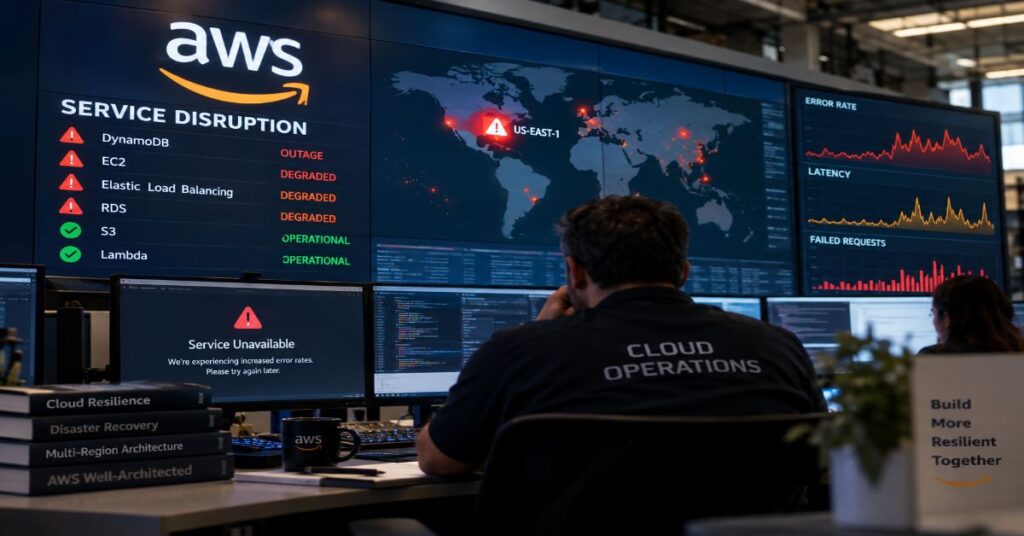
I see the central lesson of the AWS Outage story differently from most postmortems: the biggest risk is not that “the cloud can fail,” but that dependencies can remain invisible until one small control-plane fault turns into a broad service chain reaction. That pattern was exposed on October 20, 2025, when a DynamoDB DNS automation defect in AWS US-EAST-1 cascaded into problems across dependent services, instance launches, and network load balancing. In 2026, a different kind of disruption in the Middle East showed why physical regional risk also belongs in cloud planning.
For readers who mostly experience cloud infrastructure through consumer services, the distinction matters. A streaming platform can look like “one app,” yet depend on many cloud layers underneath it. Our coverage of Amazon Prime releases is a simple reminder that large digital products sit on top of complicated delivery systems. When infrastructure breaks, users usually see only the final symptom: login errors, failed payments, unavailable video, or an app that will not load.
This guide goes beyond a single incident recap. It separates confirmed root causes from speculation, compares the 2025 software-driven cascade with 2026 region-level physical disruption, explains how to check AWS status correctly, and gives a practical resilience framework for teams deciding between multi-AZ, backup-and-restore, warm standby, and multi-region designs.
Is AWS Down Right Now?
The safest answer is always time-sensitive: check AWS Health before assuming a local application problem is a global AWS incident. AWS describes its Health service as the authoritative data source for events and changes affecting cloud resources. The public Service health page shows broad events, while signed-in users can see account-specific issues that may never appear as a platform-wide outage.
The latest indexed public dashboard snapshots available during this review showed no evidence of a fresh global US-EAST-1 incident on September 10, 2026. Separate 2026 dashboard entries document prolonged disruption and recovery in the Middle East regions after physical infrastructure damage. That distinction matters because “AWS outage” can mean a global-looking cascade, a single-region event, a service-specific fault, or an account-specific impairment.
| Signal | What it tells you | Best use |
| AWS Service health | Public regional and service events | Confirm broad AWS incidents |
| AWS account health | Events tied to your resources and organization | Diagnose customer-specific impact |
| Application telemetry | Errors, latency, saturation, failed dependencies | Detect impact before a public notice |
| External monitoring | Reachability from multiple networks and geographies | Separate AWS failure from ISP or DNS issues |
| User reports | Real-world symptoms | Useful corroboration, not root-cause proof |
What Caused the Major October 2025 Failure?
AWS said the October 20, 2025 event began in US-EAST-1 with DNS resolution failures for the regional DynamoDB endpoint. Its later post-event explanation identified a latent race condition inside the automated DNS management system. Two independent automation components interacted in an unusual sequence, leaving an incorrect empty DNS record that the system did not repair automatically.
That first failure did not stay neatly inside DynamoDB. Services and customer applications that needed new DynamoDB connections could not resolve the endpoint. Recovery then exposed additional pressure in internal systems, including EC2 instance launch workflows and Network Load Balancer health checks. The result was a cascading event rather than a single broken database endpoint.
| Stage | Failure mechanism | Why impact expanded |
| 1. DynamoDB DNS | Regional endpoint could not resolve correctly | Applications and AWS services could not create new connections |
| 2. Dependency cascade | Services relying on DynamoDB inherited failures | A local control-plane defect reached many products |
| 3. EC2 launch pressure | New instance launches were throttled or failed | Autoscaling and replacement capacity became harder |
| 4. Load balancer impairment | Health-check and network state issues increased connection errors | Recovery traffic created secondary symptoms |
| 5. Backlog recovery | Queued work drained after core services returned | Users continued seeing errors after the initial fix |
Cisco ThousandEyes independently observed that the event behaved like an AWS-internal failure rather than a broad Internet transit problem, and its later analysis also described the outage as a roughly 15-hour cascade when secondary effects are included. That is why simple claims such as “AWS was down for three hours” can be misleading: the initial DNS issue was mitigated earlier than every dependent service returned to normal.
The 2026 Disruptions Changed the Risk Model
The 2025 incident was fundamentally a software and automation failure. The 2026 Middle East incidents were materially different. AWS Health updates reported physical impacts to infrastructure in the UAE and Bahrain during regional conflict, including structural damage, power disruption, and prolonged impairment. AWS advised affected customers to migrate accessible resources to other regions and restore inaccessible resources from remote backups.
This is the information-gain point most older outage articles miss: cloud resilience is no longer only about software bugs, configuration mistakes, or overloaded internal systems. Region selection also carries geopolitical, physical, power, and recovery-access risk. A design that passes a normal high-availability review can still fail a business-continuity test if its backups, identity plane, operational tooling, and runbooks depend on the same geography.
For media and streaming businesses, this matters because service continuity is judged by the viewer, not by the architecture diagram. Our site also tracks large streaming ecosystems such as Disney+ Hotstar releases, where users expect uninterrupted access even though delivery depends on many upstream systems. The same user-experience logic applies to commerce, gaming, finance, SaaS, and connected devices.
Why One AWS Region Can Affect So Much of the Internet
AWS remained the largest cloud infrastructure provider in Q2 2026 with a 28% worldwide market share, according to Synergy Research Group. Market share alone does not prove that every major site depends on AWS, but it shows the scale of the provider and the concentration of workloads that can share common regional dependencies.
US-EAST-1 has additional importance because it is one of AWS’s oldest and most heavily used regions. Some applications deliberately deploy there for service availability, ecosystem maturity, or historical reasons. Other systems may run elsewhere but still depend on global or control-plane functions that touch US-EAST-1. This can create a hidden dependency graph that is broader than the visible production footprint.
Four Things People Commonly Get Wrong
- “Multi-cloud automatically prevents outages.” It does not. If identity, DNS, observability, deployment pipelines, or data remain centralized, adding a second cloud can create complexity without independent recovery.
- “Multi-region is always the correct answer.” AWS guidance explicitly says many workloads are sufficiently resilient with a well-designed multi-AZ deployment. Multi-region should be driven by recovery objectives, regulatory needs, or region-level threat models.
- “The status page will tell us first.” Public health dashboards are important, but application telemetry and external probes can detect user impact before a provider publishes a broad incident update.
- “If the root cause is fixed, the outage is over.” Queues, retries, autoscaling delays, cache misses, expired sessions, and downstream backlogs can keep customer-facing errors elevated after the initiating defect is mitigated.
A Practical Resilience Decision Framework
The right architecture starts with business impact, not with a fashionable diagram. AWS documentation recommends multi-AZ as the normal high-availability baseline and multi-region for workloads that need protection from region-wide failure or bounded recovery times. Teams should translate that into measurable targets before selecting a pattern.
| Workload profile | Typical pattern | Recovery expectation | Trade-off |
| Non-critical content | Backup and restore | Hours | Lowest cost, longest interruption |
| Important internal service | Multi-AZ plus tested backups | Minutes to hours | Good resilience without cross-region complexity |
| Revenue-critical application | Warm standby in second region | Minutes | Higher cost and operational burden |
| Mission-critical service | Multi-region active-active | Near real time | Highest complexity, data consistency and cost challenges |
1. Define RTO and RPO Before Buying Redundancy
Recovery Time Objective is how long the service can be unavailable. Recovery Point Objective is how much recent data the business can afford to lose. If no one can state those numbers, architecture discussions usually drift toward either under-building or expensive over-engineering.
2. Inventory Hidden Regional Dependencies
Map identity, DNS, secrets, CI/CD, monitoring, queues, databases, object storage, third-party APIs, and operator access. The 2025 incident showed how a dependency such as DynamoDB DNS can amplify through services that look unrelated at the product level.
3. Test Failover, Not Just Backups
A backup that has never been restored is only a promise. A standby region that has never received production traffic is also unproven. Exercises should verify data recovery, DNS changes, certificates, credentials, traffic steering, capacity, and human access under degraded conditions.
4. Design Retry Behavior Carefully
Retries can help transient failures, but unbounded retries can create retry storms that increase pressure during recovery. Use exponential backoff, jitter, idempotency, queue controls, and circuit breakers where appropriate. Recovery should reduce load on impaired dependencies, not multiply it.
5. Separate Safety, Availability, and Security
Availability incidents can resemble cyberattacks to users, but the 2025 AWS event was not reported as a malicious attack. Teams should still preserve security controls during failover. Emergency access, secondary credentials, and recovery infrastructure should not become weaker paths around normal governance.
The same principle applies to consumer guidance: platform availability and platform safety are different questions. Our explainers on Bolly4u risks and alternatives and Vegamovies legal status and alternatives focus on safe access choices, while an AWS incident is an infrastructure availability problem. Keeping those categories separate prevents users from mistaking service failure for evidence of compromise.
What an AWS Outage Means for Different Readers
For everyday users
If several unrelated apps fail at once, do not immediately reset every device or assume your home Internet is broken. Check the affected app’s own status page, then AWS Health if the service is known to use AWS. Local troubleshooting still matters, but simultaneous failures across different products are a strong clue that the problem is upstream.
For developers and SRE teams
Treat provider health as one signal among many. Alert on customer journeys, dependency error rates, DNS resolution, queue age, failed instance launches, and cross-region health. Incident response should include a decision point for when to fail over, when to throttle, and when to stop automated recovery actions that may make congestion worse.
For executives and risk owners
Ask whether the business can recover from a regional failure without the same region’s identity, dashboards, or deployment pipeline. If the answer is no, the problem is governance and operating design as much as infrastructure. The 2026 Middle East events make this question more concrete because physical access and facility recovery can take far longer than a software rollback.
The Future of AWS Outages in 2027
The most likely change in 2027 is not the disappearance of outages. It is better fault isolation, more automated recovery guardrails, and more deliberate customer use of region-level resilience for workloads that truly need it. AWS disabled the faulty DynamoDB DNS automation involved in the 2025 event while safeguards were developed, which is a typical post-incident response: reduce the probability of the exact failure mode, then strengthen detection and recovery.
At the same time, cloud demand is still expanding quickly. Synergy reported that worldwide cloud infrastructure spending reached $143 billion in Q2 2026 and grew 43% year over year. More cloud adoption means more value concentrated in shared infrastructure, so even rare incidents can remain highly visible.
The uncertain variable is how much region-level physical and geopolitical risk changes architecture choices. Not every organization needs active-active deployment across continents. But businesses in regulated, safety-critical, or highly time-sensitive sectors are likely to spend more effort proving that backups, identity, data replication, and operational access survive the loss of an entire region, not just an availability zone.
Key Takeaways
- The October 2025 incident began with a DynamoDB DNS automation race condition in US-EAST-1, then expanded through dependent services and recovery systems.
- AWS Health should be the first authoritative check for broad service issues, while signed-in account health and application telemetry provide more specific visibility.
- The 2026 Middle East disruptions show that region-level resilience must account for physical and geopolitical risk, not only software faults.
- Multi-AZ is the right baseline for many workloads; multi-region is appropriate when business recovery requirements justify the added complexity.
- Retries, queues, autoscaling, and backlogs can extend customer-visible impact after the initial root cause has been fixed.
- A strong disaster-recovery design proves failover through exercises, not diagrams or untested backups.
Conclusion
The most useful way to understand an AWS outage is as a dependency problem, not a single-provider headline. The October 2025 failure showed how a small automation defect in a foundational service could propagate through DNS, compute launches, load balancing, and customer applications. The 2026 Middle East disruptions added a second lesson: a cloud region is still physical infrastructure exposed to real-world events.
For most organizations, the answer is not to duplicate every workload across multiple providers or regions. It is to know what must survive, define recovery targets, remove hidden single points of failure, and test the exact path back to service. AWS itself recommends multi-AZ resilience for many workloads and multi-region only when requirements justify it. That is a more practical standard than treating every outage as proof that the entire cloud model is broken.
Readers following large online platforms should apply the same distinction between a visible consumer service and the complex infrastructure layers that keep it available.
Frequently Asked Questions
What caused the AWS outage in October 2025?
AWS said a latent race condition in DynamoDB’s automated DNS management system created an incorrect empty DNS record for the regional endpoint in US-EAST-1. The DNS failure then cascaded into dependent AWS services and customer applications, with later recovery pressure affecting EC2 launches and network load balancers.
How long did the 2025 AWS outage last?
The initiating DynamoDB DNS problem was mitigated within a few hours, but secondary effects continued much longer. AWS reported all services back to normal by 3:01 p.m. PDT on October 20, while independent analysis described the broader cascade as lasting roughly 15 hours.
Is AWS down right now?
AWS status changes minute by minute. Check the AWS Health Dashboard for public events and, if you are a customer, sign in to view account-specific health. Application telemetry and external monitoring should also be used because not every issue is global.
Was the major AWS outage a cyberattack?
AWS did not attribute the October 2025 incident to a cyberattack. Its post-event explanation described an internal automation defect and cascading infrastructure issues.
Does multi-region architecture prevent every AWS outage?
No. Multi-region can reduce exposure to a region-wide failure, but it introduces complexity around data replication, identity, traffic routing, cost, and operations. AWS guidance says many workloads are adequately served by a well-architected multi-AZ design.
What is the difference between multi-AZ and multi-region?
Multi-AZ spreads a workload across separate Availability Zones inside one AWS Region and protects against many localized failures. Multi-region places recovery or active capacity in another Region, adding protection against region-wide events at higher cost and operational complexity.
What should a business do after an AWS service disruption?
Review the incident against your RTO and RPO, identify hidden dependencies, test restoration and failover, tune retry behavior, verify backups in another fault domain, and update runbooks. The goal is to reduce repeat impact rather than only document the provider root cause.
Methodology
Our desk reviewed the current AWS Health documentation, AWS public service-health records, Amazon’s October 2025 incident update, AWS architecture and Well-Architected guidance, Synergy Research Group cloud market data, and independent outage analysis from Cisco ThousandEyes. We also compared the dominant search-result patterns for the keyword to avoid reproducing the same narrow “what happened” structure.
Known limitation: public health pages do not expose every account-specific event, and search indexes can lag live status changes. Availability and incident status should therefore be rechecked immediately before publication if the article is presented as a live status update. Forward-looking 2027 analysis is based on current resilience guidance and market growth trends, not a prediction that a specific outage will occur.
This article was drafted with AI assistance and reviewed by the FilmyZilla2023 Editorial Team. All data, citations, and claims have been independently verified against primary sources.
References
- Amazon Web Services. (2025). AWS service disruption update and post-event summary.
- Amazon Web Services. (2026). AWS Health Dashboard.
- Amazon Web Services. (2025). Enhance the resilience of critical workloads by architecting with multiple AWS Regions.
- Amazon Web Services. (2026). Multi-Region Architecture, AWS Prescriptive Guidance.
- Amazon Web Services. (2026). Shared Responsibility Model for Resiliency.
- Synergy Research Group. (2026, July 30). Q2 cloud market passes $143 billion; highest growth rate in eight years.
- Cisco ThousandEyes. (2025). AWS outage analysis: October 20, 2025.
- O’Flaherty, K. (2025, October 23). AWS outage latest: New analysis explains what went wrong and why. Forbes.
- Bishop, T. (2025, October 23). How the AWS outage happened. GeekWire.