
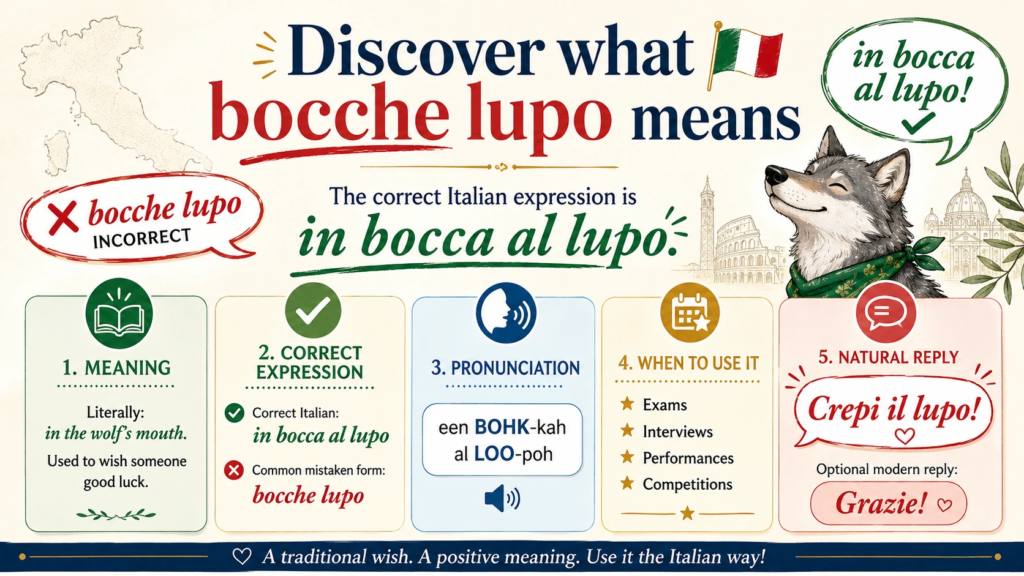
I often find that the most memorable expressions in another language are the ones that make the least sense when translated word for word. The keyword bocche lupo leads us to a perfect example. What many people are trying to find is the well-known Italian expression in bocca al lupo, which Italians use to wish someone good luck before an exam, performance, competition, interview, journey, or other demanding situation.
Literally, the complete expression refers to being “in the mouth of the wolf.” That image may sound dangerous rather than encouraging, but idioms rarely work through literal translation alone. In my analysis, the phrase is better understood as an Italian cultural equivalent of “break a leg.” Both expressions deliberately mention an undesirable event while communicating a positive wish.
The spelling matters here. Bocche lupo is not the standard expression, and it would sound incomplete to an Italian speaker. The proper wording requires the prepositions in and al, while bocca remains singular. Throughout this guide, I will explain why the correct form is in bocca al lupo, what each word contributes, how Italians reply, and why competing stories about the phrase’s origin continue to circulate.
Key Takeaways
- Bocche lupo is usually a misspelling or shortened search form of in bocca al lupo.
- The correct phrase means “good luck,” despite literally referring to the mouth of a wolf.
- Italians commonly use it before exams, performances, competitions, interviews, and difficult tasks.
- The traditional reply is crepi or crepi il lupo, meaning roughly “may the wolf die.”
- Grazie, meaning “thank you,” is also understandable in ordinary conversation, although it does not preserve the traditional ritual.
- Historical linguistic research connects the expression with superstition, danger, hunters, and the belief that words could influence fortune.
- The popular story that a mother wolf protects her cubs in her mouth is a modern reinterpretation rather than the strongest documented origin.
- The expression is friendly and natural, but it is not normally used in highly formal written communication.
What Bocche Lupo Actually Means
The first point I would clarify is that bocche lupo is not a complete Italian phrase. It appears frequently as a search query because learners may hear the expression quickly, remember only its most noticeable sounds, or write the words without knowing where one part ends and another begins.
The standard expression is:
In bocca al lupo
Its practical meaning is:
Good luck
Its literal image is:
In the mouth of the wolf
Cambridge’s Italian-English dictionary translates in bocca al lupo as a wish for good luck, and its entries for both bocca and lupo identify the expression as an established Italian formula rather than a sentence that should be interpreted literally.
Why Bocche Is Not Correct in the Expression
The noun bocca means “mouth.” Its plural is bocche, meaning “mouths.” Consequently, bocche lupo loosely resembles the disconnected words “mouths wolf,” but it does not form the traditional expression.
The idiom uses one mouth, so Italians say bocca, not bocche. They also need the surrounding grammatical elements:
- in means “in” or “into”
- bocca means “mouth”
- al is the contraction of a + il
- lupo means “wolf”
The phrase therefore presents a complete relationship between the person, the mouth, and the wolf. Removing the prepositions or changing bocca to bocche destroys that structure.
Why Learners Hear Bocche Lupo
Spoken Italian connects words smoothly. When a native speaker says in bocca al lupo, the boundaries between bocca, al, and lupo may not be obvious to a beginner. The doubled consonant in bocca also affects its rhythm, and a learner who has not seen the phrase written may guess that the word is bocche.
In my view, this is a normal listening error rather than a serious language mistake. The practical solution is to learn the entire expression as one unit instead of memorizing isolated words. Think of in bocca al lupo as a fixed formula, just as an English learner might memorize “break a leg” without rebuilding it from the words “break,” “a,” and “leg.”
Breaking Down In Bocca al Lupo Word by Word
A word-by-word analysis helps us understand the grammar, but it should not replace the idiomatic meaning. The following table separates the phrase into its essential components.
| Italian element | Basic meaning | Grammatical role | Practical note |
|---|---|---|---|
| In | In or into | Preposition | Introduces the location or situation |
| Bocca | Mouth | Feminine singular noun | The idiom uses the singular, not bocche |
| Al | To the or at the | Contraction of a and il | Connects bocca with lupo |
| Lupo | Wolf | Masculine singular noun | Represents danger in the traditional image |
| In bocca al lupo | Literally, in the wolf’s mouth | Fixed idiomatic expression | Means “good luck” in normal usage |
The most important lesson from this table is that literal meaning and communicative meaning operate on different levels. A word-for-word translation tells us what picture the phrase creates, while the idiomatic translation tells us what the speaker intends.
A learner who translates only the individual words might assume that the speaker is describing danger. An Italian listener, however, recognizes the full phrase immediately as encouragement. This difference demonstrates why idioms should be learned in context rather than through dictionary substitution alone.
How Italians Use In Bocca al Lupo
Italians use in bocca al lupo when someone is about to face a challenge or uncertain outcome. The phrase does more than predict success. It communicates emotional support, acknowledges the difficulty ahead, and shows that the speaker cares about the result.
Cambridge gives the expression a direct and uncomplicated English equivalent:
“Good luck!”
Cambridge Italian-English Dictionary
That short translation captures the practical function, although it does not convey the phrase’s cultural flavor. When someone chooses in bocca al lupo instead of the more literal buona fortuna, the wish can sound more traditionally Italian, more conversational, and sometimes more affectionate.
Common situations include:
- Before a school or university examination
- Before a job interview
- Before an audition or theatre performance
- Before a sports competition
- Before an important presentation
- Before a medical procedure
- Before a driving test
- Before the beginning of a difficult project
- Before submitting an application
- Before travelling for an important purpose
The Sabatini Coletti dictionary describes the expression as a superstitious formula used to wish good fortune to hunters, students, and people preparing for something difficult or demanding.
READ: Misned Meaning, Name Origins, People, Companies, and Spelling Variants
A Student Example
Imagine that Marco has an oral examination the next morning. His friend might say:
In bocca al lupo per l’esame di domani!
This means:
Good luck with tomorrow’s exam!
Marco could answer:
Crepi!
The exchange is short, natural, and culturally familiar. The friend is not talking about wolves in any practical sense. Both speakers understand the expression as a conventional wish.
A Workplace Example
Suppose Elena is about to present a proposal to senior managers. A colleague might tell her:
In bocca al lupo per la presentazione.
Elena could respond:
Grazie mille!
Although crepi is the traditional reply, grazie mille is a straightforward expression of appreciation. In real communication, clarity and warmth matter more than treating the exchange like a rigid test.
A Performance Example
Before an actor enters the stage, another performer may say:
In bocca al lupo!
This resembles the English theatrical expression “break a leg.” Both formulas avoid a direct statement of good fortune and instead use an apparently negative image to express the opposite intention.
The Historical Origin of In Bocca al Lupo
The precise history of an old idiom is rarely as simple as one dramatic story. In this case, the most reliable linguistic account connects in bocca al lupo with danger, superstition, hunting, and a rhetorical device known as antiphrasis.
Antiphrasis involves saying something that appears to express one idea while intending the opposite. “Break a leg” is a familiar English example. The speaker does not desire an injury. The negative wording is part of a ritual that supposedly avoids tempting bad luck.
The Accademia della Crusca, Italy’s leading institution for the study of the Italian language, reports that dictionaries generally agree on the expression’s protective or apotropaic function. An apotropaic formula is intended to turn away harm or bad fortune.
The institution summarizes this aspect of the phrase as:
“una funzione apotropaica, capace di allontanare lo scongiuro”
Accademia della Crusca
In English, this describes a protective function associated with warding off an unlucky outcome. The historical logic is not that the speaker truly wants someone to enter a wolf’s mouth. The frightening image works as a verbal shield against the danger it names.
The Connection with Hunters
According to the Accademia della Crusca, the expression appears to have developed from an old formula directed at hunters. The wish operated through antiphrasis, and the customary response was crepi, with il lupo understood but not always spoken. From the hunting world, the expression expanded into other difficult situations where people wanted luck and protection.
This explanation makes cultural sense. A wolf represented a genuine threat in societies where people travelled through forests, protected livestock, or hunted in dangerous conditions. To end up in the wolf’s mouth meant facing the worst possible outcome.
By naming that outcome, speakers symbolically attempted to prevent it. The response crepi il lupo, meaning “may the wolf die,” completed the protective exchange by imagining that the danger itself would be defeated.
Earlier Uses of the Wolf’s Mouth
The image existed before the modern good-luck formula became widespread. The Accademia della Crusca notes that an early Italian expression meaning “to go into the wolf’s mouth” referred to falling into an enemy’s power or voluntarily encountering danger. It cites a medieval example associated with Guittone d’Arezzo and records similar dictionary uses in later centuries.
The first edition of the Accademia’s historic vocabulary, published in 1612, characterized the wolf as an extremely voracious wild animal. Later lexicographic evidence preserved expressions in which entering the wolf’s mouth meant entering danger, becoming prey, or falling into hostile hands.
From my perspective, this historical evidence is stronger than explanations built only around the biological behaviour of wolves. It shows that “the wolf’s mouth” already functioned in Italian as an image of danger. The later good-luck formula reversed that threatening meaning through superstition and ritual.
The Popular Mother Wolf Explanation
A widely shared modern explanation claims that the phrase is positive because a mother wolf carries her cubs in her mouth to protect or move them. According to this interpretation, being in the wolf’s mouth represents safety rather than danger, and the ideal reply should be grazie or viva il lupo instead of crepi il lupo.
I understand why this story appeals to people. It replaces an image of killing with one of protection, and it presents wolves as caring animals rather than fairy-tale villains. It is emotionally attractive, easy to remember, and well suited to social media.
However, the documented linguistic history presented by the Accademia della Crusca points in another direction. The institution connects the expression with an apotropaic hunting formula and identifies crepi as the traditional response. It also places the idiom within a much older European tradition in which the wolf represents danger, hunger, violence, and hostile power.
For that reason, I would treat the mother wolf explanation as a modern reinterpretation, not as the established historical origin. A language can acquire new associations over time, so modern speakers are free to prefer grazie or viva il lupo for ethical or personal reasons. That modern preference should simply be distinguished from historical evidence.
Why the Wolf Became a Symbol of Danger
The historical role of the wolf is essential to understanding the phrase. In modern life, many people encounter wolves mainly in nature documentaries, conservation discussions, stories, or symbolic imagery. Earlier European communities had a more immediate relationship with the animal.
Wolves could threaten livestock, appear near settlements, and become associated with forests, hunger, winter, darkness, and vulnerability. Over time, this fear entered stories and expressions. The Accademia della Crusca identifies numerous Italian phrases in which the wolf represents danger, appetite, aggression, persistence, or harsh conditions.
Examples include:
- Gridare al lupo, meaning to raise an alarm or “cry wolf”
- Una fame da lupi, meaning extreme hunger
- Tempo da lupi, meaning severe or terrible weather
- Il lupo perde il pelo ma non il vizio, meaning someone may change outwardly without changing their nature
- Un lupo in veste d’agnello, meaning a dangerous person disguised as harmless
The same symbolic patterns appear in other European languages. English uses “cry wolf,” “a wolf in sheep’s clothing,” and “keep the wolf from the door.” French, German, and Polish also preserve expressions that connect wolves with hunger, danger, deceit, or hardship.
In my view, this wider linguistic pattern supports the traditional explanation. The wolf in in bocca al lupo is not primarily a zoological animal. It is a cultural symbol of the dangerous situation a person hopes to survive.
How In Bocca al Lupo Compares with Break a Leg
The closest English equivalent is usually break a leg, especially in theatrical or performance settings. Both expressions sound negative when interpreted literally, yet both communicate encouragement.
The comparison is useful because it teaches learners not to judge an idiom by its surface image. An English speaker does not become alarmed when someone says “break a leg” before a performance. In the same way, an Italian speaker does not imagine a wolf attack when hearing in bocca al lupo.
| Expression | Language | Literal image | Intended meaning | Typical setting |
|---|---|---|---|---|
| In bocca al lupo | Italian | In the wolf’s mouth | Good luck | Exams, interviews, performances, competitions, difficult tasks |
| Break a leg | English | Suffer a leg injury | Good luck | Traditionally theatre, now sometimes broader |
| Buona fortuna | Italian | Good fortune | Good luck | General and direct |
| Best of luck | English | A strong wish for luck | Good luck | General, neutral, and widely applicable |
| Crepi il lupo | Italian | May the wolf die | Traditional reply | Response to in bocca al lupo |
The main distinction is range. “Break a leg” remains strongly associated with performance, even though people sometimes use it elsewhere. In bocca al lupo has broader everyday use and may be heard before an exam, interview, match, presentation, or other important challenge.
I would therefore translate according to context rather than mechanically. During a theatre rehearsal, “break a leg” is ideal. Before a university examination, “good luck” is more natural in English, even though the Italian speaker may still choose in bocca al lupo.
What to Say in Reply to In Bocca al Lupo
The traditional response is:
Crepi!
The complete version is:
Crepi il lupo!
The verb crepare can mean “to die” or “to croak” in an informal or forceful sense. In this formula, crepi functions as an expression of hope or command, roughly meaning “may it die.”
Treccani identifies crepi or crepi il lupo as the traditional response to the good-luck formula.
The dictionary’s wording is clear:
“la risposta tradizionale è: crepa!, o crepi il lupo!”
Treccani
The ritual logic is simple. One person names the danger by saying “into the wolf’s mouth.” The other symbolically defeats that danger by answering “may the wolf die.”
Is Grazie an Acceptable Reply?
Grazie means “thank you,” and it is readily understood. It expresses appreciation for the positive intention behind the phrase. A learner who replies grazie has not created confusion or insulted the speaker.
However, grazie does not complete the traditional superstitious formula. Someone who wants to sound culturally knowledgeable should learn crepi first. It is the reply most consistently documented by major Italian dictionaries and by the Accademia della Crusca.
My practical recommendation is:
- Use crepi when you want the traditional and recognizably Italian response.
- Use grazie when you prefer a simple, polite acknowledgement.
- Use grazie, crepi! when you want to combine appreciation with tradition.
- Understand viva il lupo, but recognize that it reflects a modern reinterpretation rather than the documented historical formula.
Is Crepi Rude?
Outside this expression, crepare can sound harsh because it refers to dying. Inside the fixed response crepi il lupo, however, the phrase is conventional rather than personally aggressive. The speaker is not wishing death on another person.
Tone still matters. A friendly crepi! after someone wishes you luck sounds natural. Directing the verb at a person in another context could be offensive. This is another reason to learn expressions as complete units rather than assuming that every component carries the same tone everywhere.
How to Pronounce In Bocca al Lupo
A practical approximation for English speakers is:
een BOK-kah al LOO-poh
The stress falls strongly on the first syllable of bocca and the first syllable of lupo.
Several details deserve attention:
- In sounds closer to “een” than the English word “in.”
- The double cc in bocca should be held slightly longer than a single consonant.
- The vowels remain clear and relatively consistent.
- Lupo has two distinct syllables: lu-po.
- The phrase should flow naturally without swallowing the word al.
A common learner pronunciation is to say boka with a very light consonant. Italian distinguishes single and doubled consonants, so giving the cc a little extra length makes the phrase sound more accurate.
Another mistake is stressing the final syllable of lupo. The normal stress is LU-po, not lu-PO.
I recommend practising the expression in short rhythmic groups:
In bocca | al lupo
After that becomes comfortable, say it as one connected phrase:
In bocca al lupo!
The goal is not to create an exaggerated accent. Clear vowels, the doubled consonant, and correct stress will make the expression understandable.
Practical Bocche Lupo Examples for Everyday Situations
The best way to remember an idiom is to attach it to situations in which a real person would use it. The following examples are hypothetical, but they reflect ordinary conversational patterns.
Before an Examination
Italian: In bocca al lupo per l’esame!
English: Good luck with the exam!
Reply: Crepi!
The preposition per introduces the event or purpose. This structure is extremely useful:
In bocca al lupo per + noun
Examples include:
- per l’intervista, for the interview
- per la gara, for the competition
- per il colloquio, for the interview or meeting
- per il progetto, for the project
- per domani, for tomorrow
Before a Job Interview
Italian: Domani hai il colloquio, vero? In bocca al lupo!
English: Your interview is tomorrow, right? Good luck!
Reply: Grazie, crepi!
This reply sounds friendly because it combines gratitude with the customary response.
Before a Sports Match
Italian: In bocca al lupo per la partita di stasera!
English: Good luck with tonight’s match!
A coach, friend, family member, or teammate could use the phrase. The expression wishes the person success without making a prediction about the final result.
Before a Theatre Performance
Italian: In bocca al lupo per lo spettacolo!
English: Break a leg for the show!
This is one of the contexts where the idiomatic English translation “break a leg” works especially well.
Before a Medical Procedure
Italian: In bocca al lupo per l’intervento. Ti penso.
English: Good luck with the procedure. I’m thinking of you.
In a sensitive context, tone becomes more important than superstition. The additional sentence makes the message warmer and more personal.
Before Starting a New Role
Italian: In bocca al lupo per il tuo nuovo lavoro!
English: Best of luck with your new job!
Here the phrase marks a transition and acknowledges that the person is entering a new and uncertain situation.
In a Text Message
Domani è il grande giorno. In bocca al lupo!
This means:
Tomorrow is the big day. Good luck!
The expression works naturally in text messages, social media comments, and informal emails. An exclamation mark is common because the phrase expresses encouragement.
How to Use Bocche Lupo Correctly Step by Step
Because bocche lupo is a common search form, I would correct it through a simple sequence rather than trying to memorize several grammatical rules at once.
Step 1: Replace Bocche with Bocca
The idiom uses singular bocca, meaning one mouth. Do not use the plural bocche.
Incorrect:
Bocche lupo
Correct core noun:
Bocca
Step 2: Add In at the Beginning
The phrase begins with the preposition in:
In bocca
This creates the meaning “in the mouth.”
Step 3: Add Al Before Lupo
The phrase does not say bocca lupo. It uses al to connect the mouth with the wolf:
In bocca al lupo
Step 4: Use It Before a Challenge
Say the expression when the other person is approaching something uncertain, demanding, competitive, or emotionally important.
Suitable example:
In bocca al lupo per il colloquio!
Less suitable example:
Saying it after someone has already received a confirmed result. At that point, congratulations or sympathy would usually be more appropriate.
Step 5: Learn the Expected Reply
When someone says it to you, answer:
Crepi!
This one-word response is enough. You do not need to repeat the entire phrase.
Step 6: Adapt the Translation to the Situation
Do not always translate it as “in the wolf’s mouth.” That version explains the literal image but not the communicative meaning.
Use:
- “Good luck” in most situations
- “Best of luck” in supportive or slightly formal contexts
- “Break a leg” before a performance
Step 7: Listen for It as a Fixed Unit
When watching Italian films, interviews, competitions, or everyday conversations, listen for the full rhythm of in bocca al lupo. Repeated exposure will help prevent spelling errors such as bocche lupo, in boca lupo, or imbocca al lupo.
Common Mistakes and Misconceptions
Several mistakes appear repeatedly because learners try to interpret the expression through sound, literal translation, or incomplete online explanations.
Writing Bocche Lupo
This is the most relevant error for the target keyword. Bocche is plural, and the phrase is missing the necessary prepositions. The correction is in bocca al lupo.
Writing In Boca al Lupo
Italian uses bocca with a doubled c. A single c changes the spelling and fails to represent the standard Italian word.
Writing Imbocca al Lupo
Imbocca can be a form of the verb imboccare, which has meanings such as entering a road or feeding someone. It is not the opening of this idiom. The correct phrase contains two separate words:
in bocca
Translating It as a Threat
The literal image is dangerous, but the expression is supportive. Context tells the listener that the speaker is offering encouragement.
Assuming Buona Fortuna Is Wrong
Buona fortuna is valid Italian. The difference is mainly one of style and cultural flavour. In bocca al lupo is more idiomatic and often more conversational, while buona fortuna states the wish directly.
Believing There Is Only One Socially Permitted Reply
The documented traditional reply is crepi. Nevertheless, ordinary speakers may choose grazie, especially when they prefer direct politeness or dislike the image of the wolf dying. A learner should know the traditional pattern without treating every variation as a communication failure.
Treating the Mother Wolf Story as Certain History
The protection story is memorable, but authoritative historical research links the phrase with danger, hunters, antiphrasis, and superstition. I believe responsible explanations should distinguish a modern symbolic interpretation from a documented linguistic origin.
Using It After the Outcome Is Known
A good-luck wish belongs before the uncertain event. After success, use complimenti, meaning “congratulations,” or bravo/brava, depending on the situation.
Expert Recommendations for Learning Italian Idioms
My first recommendation is to store idioms as complete expressions. A phrase such as in bocca al lupo should occupy one mental entry, connected directly with the idea of wishing someone luck.
Breaking it into grammar is helpful during study, but real conversation requires quick recognition. When an Italian says the phrase, you should not need to translate each word before understanding the intention.
Second, learn the social response at the same time. Memorize the pair:
In bocca al lupo!
Crepi!
This method resembles learning both a greeting and its answer. Knowing only the first half can leave a learner uncertain when someone uses the expression unexpectedly.
Third, compare idioms by function rather than imagery. Connect in bocca al lupo with “good luck” and “break a leg,” not with literal vocabulary about animals. Functional comparison helps you select a natural translation.
Fourth, notice register. Babbel classifies in bocca al lupo among widely used conversational Italian expressions and gives crepi il lupo as the response. Its guide also advises learners to consider audience and context when choosing informal language.
Finally, verify colourful origin stories before repeating them as fact. Idioms attract myths because people naturally want a neat explanation for strange wording. Historical dictionaries, dated examples, and specialist language institutions usually provide a more reliable foundation than an unsourced viral post.
Quick Reference for Using In Bocca al Lupo
The following table provides a practical decision guide for learners who want to use the expression confidently.
| Situation | Recommended Italian phrase | Natural reply | English equivalent |
|---|---|---|---|
| Friend taking an exam | In bocca al lupo per l’esame! | Crepi! | Good luck with the exam |
| Colleague attending an interview | In bocca al lupo per il colloquio! | Grazie, crepi! | Best of luck with the interview |
| Actor before a performance | In bocca al lupo per lo spettacolo! | Crepi il lupo! | Break a leg |
| Athlete before a match | In bocca al lupo per la partita! | Crepi! | Good luck with the match |
| Friend beginning a project | Un grande in bocca al lupo! | Grazie! | Wishing you lots of luck |
| Formal business letter | Ti auguro il meglio per il progetto | Grazie | I wish you the best with the project |
| After someone succeeds | Complimenti! | Grazie! | Congratulations |
| Learner unsure of the response | In bocca al lupo! | Grazie, crepi! | Thank you, and may the wolf die |
The table shows that in bocca al lupo is flexible but not universal. It works best before a challenge and in a supportive interpersonal setting. For highly formal writing, a direct expression such as ti auguro il meglio may fit the tone better. After the event, the language should change from wishing luck to acknowledging the result.
Conclusion
I believe the central lesson behind bocche lupo is that hearing the right sounds is only the first step in understanding an idiom. The correct Italian expression is in bocca al lupo, and its communicative meaning is “good luck,” even though its literal image places someone in the mouth of a wolf.
Historical evidence connects the phrase with danger, hunters, superstition, and the protective use of negative wording. The customary response crepi completes that ritual by symbolically defeating the wolf. Modern speakers may also answer grazie, but learners should recognize crepi il lupo as the traditional form supported by major dictionaries and the Accademia della Crusca.
From my perspective, the most effective next action is to practise the phrase as a complete conversational pair rather than as separate vocabulary. Say in bocca al lupo before an exam, interview, performance, competition, or difficult task, and be ready to answer crepi when someone says it to you. Once that exchange becomes automatic, the unusual image stops feeling confusing and starts sounding naturally Italian.
Frequently Asked Questions
What Does Bocche Lupo Mean in English?
Bocche lupo is generally a mistaken or incomplete version of in bocca al lupo, which means “good luck” in English. The correct phrase literally creates the image of being “in the wolf’s mouth,” but Italians use it as encouragement before a challenging event. Depending on context, it can be translated as “good luck,” “best of luck,” or “break a leg.”
Is Bocche Lupo Correct Italian?
No, bocche lupo is not the correct form of the traditional expression. Bocche means “mouths,” while the idiom requires the singular noun bocca. It also needs the prepositions in and al. The complete and correct phrase is in bocca al lupo.
What Is the Literal Translation of In Bocca al Lupo?
The literal translation is “in the mouth of the wolf.” That translation explains the words but not the intended message. As an idiom, in bocca al lupo means “good luck.” Italian dictionaries consistently identify it as an expression used before a difficult or uncertain undertaking.
How Should I Reply to In Bocca al Lupo?
The traditional reply is crepi or crepi il lupo, meaning roughly “may the wolf die.” This response completes the superstitious exchange by imagining that the danger has been defeated. Saying grazie is understandable and polite, but crepi is the culturally traditional response documented by Treccani and the Accademia della Crusca.
Can I Say Grazie Instead of Crepi?
Yes, you can answer grazie, and the speaker will understand that you appreciate the wish. However, crepi is the conventional reply associated with the idiom. I would recommend learning crepi first, then choosing grazie when the situation or your personal preference calls for a simpler response.
Is In Bocca al Lupo the Same as Buona Fortuna?
Both expressions wish someone good luck, but they differ in style. Buona fortuna is direct and literal. In bocca al lupo is idiomatic, culturally distinctive, and connected with a traditional superstitious formula. In many everyday situations, either expression communicates the same supportive intention.
When Do Italians Say In Bocca al Lupo?
Italians say it before exams, interviews, competitions, performances, presentations, medical procedures, journeys, and other situations with an uncertain or demanding outcome. The Sabatini Coletti dictionary specifically connects the expression with hunters, students, and people preparing for difficult tasks.
Is In Bocca al Lupo Formal or Informal?
The expression is most natural in conversation, personal messages, and friendly professional exchanges. It can appear in polite settings, but highly formal documents may favour direct expressions such as ti auguro il meglio, meaning “I wish you the best.” Context, relationship, and tone should guide the choice.
Does In Bocca al Lupo Come from Mother Wolves Protecting Their Cubs?
That is a popular modern explanation, but it is not the strongest documented origin. Historical linguistic research from the Accademia della Crusca connects the expression with hunters, danger, antiphrasis, and an apotropaic attempt to ward off bad luck. The protective mother wolf story is better treated as a modern reinterpretation.
How Do You Pronounce In Bocca al Lupo?
A useful English approximation is een BOK-kah al LOO-poh. Give the doubled cc in bocca slightly more length, keep the vowels clear, and stress the first syllables of bocca and lupo. Listening to native pronunciation will help you reproduce the natural rhythm.
Sources and References
- Accademia della Crusca, historical and linguistic analysis of the origin, apotropaic function, hunting connection, and traditional response.
- Treccani, dictionary entries defining the expression and identifying crepi or crepi il lupo as the traditional reply.
- Cambridge Italian-English Dictionary, translations of bocca, lupo, and in bocca al lupo.
- Sabatini Coletti Italian Dictionary, definition of the phrase as a superstitious wish used before difficult or demanding activities.
- Babbel Magazine, contemporary learner-focused explanation of the expression and its conventional response.
Disclaimer
This article provides general language-learning and cultural information. Italian usage can vary according to region, generation, personal preference, relationship, and social setting. The historical explanation presented here prioritizes documented dictionary evidence and the research of the Accademia della Crusca, while acknowledging that modern alternative interpretations and responses also circulate among speakers.