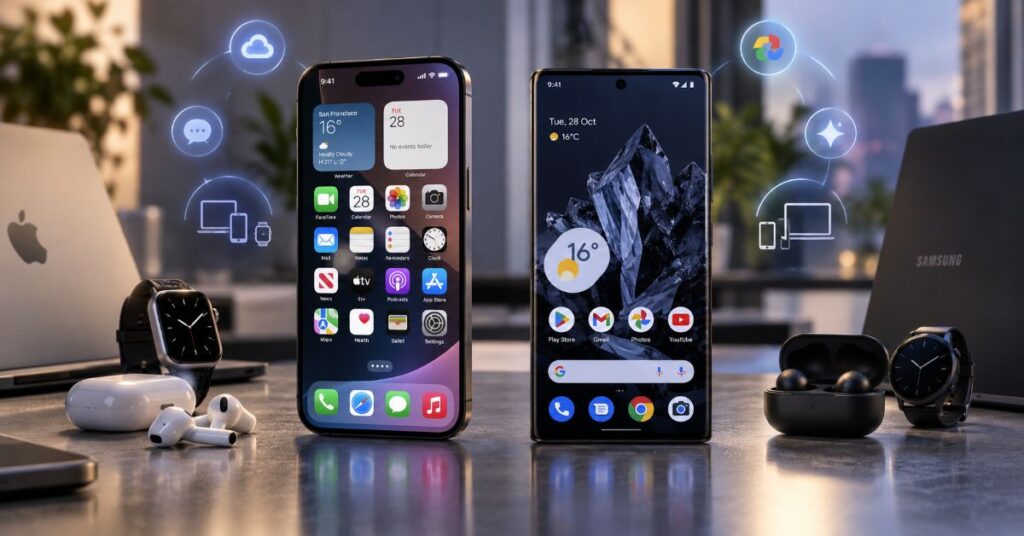
I think the old iPhone vs Android argument now hides the real buying decision. In 2026, both platforms can deliver excellent cameras, fast performance, secure payments, high-quality apps, and years of updates, but they create very different dependencies around your watch, laptop, messaging habits, cloud storage, AI tools, and future upgrades. That is why the most useful answer to iphone vs android is not a universal winner. It is a map of what becomes easier, more expensive, or harder to replace after you choose a platform. Apple released iOS 27 on September 14, 2026, with support reaching back to the iPhone 11, while Google promises seven years of OS and security updates for Pixel 8 and later. Samsung makes a similar seven-generation OS and seven-year security commitment for the Galaxy S26 series (Apple, 2026a; Google, 2026a; Samsung, 2026). Those facts narrow an old gap, but they do not erase the differences in hardware choice, software control, AI availability, or switching friction. This guide compares those differences at platform level, then shows where you should stop comparing operating systems and start comparing exact phones.
For readers who also use a phone as their main streaming screen, our Amazon Prime new releases guide is a useful reminder that content availability changes independently of the phone platform itself.
The Real 2026 Choice Is Your Dependency Map
A phone is no longer an isolated purchase. It is the key to a web of devices and services. If you already use an Apple Watch, Mac, AirPods, iCloud Photos, iMessage, and Apple Pay, an iPhone change can ripple through several daily routines. The same is true on Android when your setup depends on a Galaxy Watch, Google Photos, Gemini features, Samsung DeX, Google Messages, or manufacturer-specific tools.
This is the first gap in many competing comparisons. They score isolated features, but the expensive part of switching is often not the handset. It is replacing accessories, rebuilding workflows, moving credentials, checking banking apps, transferring eSIMs, and retraining small habits that have become automatic.
A better decision therefore starts with three questions: What devices must keep working with your next phone? Which data or messaging features would be painful to move? Which capabilities do you use every week rather than admire on a spec sheet? Those answers usually matter more than a one-point camera or benchmark advantage.
iPhone vs Android at a Glance
| Factor | iPhone | Android |
| Hardware choice | Small, Apple-controlled lineup | Very broad, from budget to foldables and gaming phones |
| Software consistency | Highly consistent across supported iPhones | Varies by manufacturer, model, and software skin |
| Long-term updates | iOS 27 supports iPhone 11 and later | Pixel 8+ and Galaxy S26 have explicit 7-year commitments; others vary |
| Customization | Moderate and increasing | Generally deeper, including launchers and more default-app control |
| App distribution | App Store plus alternative distribution in selected regions | Google Play plus manufacturer stores and broader sideloading options |
| AI | Apple Intelligence/Siri AI on supported newer models | Gemini plus model-specific Pixel, Galaxy, and OEM features |
| Messaging | iMessage plus RCS where supported | RCS is central; features vary by app and carrier |
| Best way to compare | Exact iPhone model and ecosystem fit | Exact Android model, manufacturer policy, and ecosystem fit |
Where iPhone Has the Practical Edge
Apple controls the iPhone hardware, operating system, chip design, core services, and most of the accessory framework around the device. That vertical integration can make setup and cross-device behavior more consistent. It also means a feature documented for a supported iPhone is less likely to vary by manufacturer skin or carrier-specific software.
Long software reach is another concrete strength. iOS 27 supports the iPhone 11 family, originally introduced in 2019, as well as newer models (Apple, 2026a). Apple does not publish a simple fixed support promise for every iPhone in the way Google and Samsung now do, so buyers should not convert that history into a guaranteed number for every future model. Still, the current compatibility list shows that recent iPhones can remain on a current major iOS release for many years.
The trade-off is control. Apple has expanded customization and app distribution, but alternative app marketplaces and web distribution remain region-dependent. Apple says alternative distribution is available in Brazil, Japan, and the European Union, with different rules by region (Apple, 2026b). For people who want one tightly governed software channel, that can feel reassuring. For people who want broad installation freedom, it can feel restrictive.
Where Android Has the Practical Edge
Android’s biggest advantage is not one feature. It is the range of decisions the platform lets hardware makers and buyers make. You can choose mainstream slabs, gaming-focused phones, rugged models, stylus devices, foldables, camera-first flagships, and much cheaper entry-level handsets. That variety also creates more competition around charging speed, battery capacity, display formats, and experimental hardware.
Android also gives users more freedom to change defaults, home-screen behavior, launchers, file handling, and app sources. But this flexibility creates a second-order cost: the Android experience is not one experience. A Pixel, Galaxy, OnePlus, Motorola, or other Android phone can differ in update timing, AI tools, camera processing, system apps, desktop modes, and support policies.
That is why Android buyers should treat the manufacturer as part of the operating system decision. Google’s Pixel 8 and later receive seven years of OS and security updates from their first U.S. Google Store availability, while Samsung says the Galaxy S26 series receives seven generations of OS upgrades and seven years of security updates (Google, 2026a; Samsung, 2026). A low-cost Android phone may have a very different support window.
The Hidden Cost Most Comparisons Miss: Switching Friction
Switching is much easier than it was a few years ago, but it is still not frictionless. Google says its Android setup flow can transfer photos, contacts, passwords, messages, apps and other data from an iPhone, with newer methods supporting more data types on selected Pixel and Samsung devices. It also specifically tells switchers to turn off iMessage so messages continue arriving correctly (Google, 2026b).
Apple’s Move to iOS process can transfer data from Android during initial iPhone setup, and Apple now supports a direct USB-C connection for faster transfer. Apple also notes that if setup is already complete, using Move to iOS generally requires erasing the iPhone and starting again, unless data is moved manually (Apple, 2026c).
The hidden friction is what transfer tools cannot fully standardize. Authenticator setups, banking approvals, local app data, wearable pairings, smart-home permissions, downloaded media, custom automation, paid accessories, and platform-specific subscriptions may still need manual work. Before switching, make a dependency checklist. That one step can prevent a ‘cheap’ phone change from becoming an expensive ecosystem rebuild.
Messaging Is Less Divisive, but Not Identical
RCS has reduced one of the most visible historical gaps between the platforms. Google confirms that RCS now works between Android and supported iPhones, enabling features such as high-resolution media, typing indicators, read receipts, and improved group messaging when carrier and device support are available (Google, 2026c).
However, cross-platform RCS is not the same as every participant using the same messaging stack. Google notes that RCS conversations between Android and iPhone are not end-to-end encrypted under its Google Messages encryption implementation, and availability can still depend on country and carrier (Google, 2026c). In practice, messaging is now a smaller reason to avoid switching, but it should not be treated as perfectly unified.
If your phone is also your main place for watching sports and live media, our NFLBite 2026 guide explains why service legality and availability are separate from whether you use iOS or Android.
Updates and Security: Compare the Promise, Not the Logo
The old shorthand that ‘iPhone gets updates and Android does not’ is too crude for 2026. Google and Samsung now make explicit long-term promises on flagship families, while Apple continues supporting a broad range of older iPhones on iOS 27. The more useful question is whether the exact model you are buying has a clear end date or documented support policy.
Security also depends on more than platform reputation. Patch speed, hardware-backed security, app permissions, account recovery, theft protection, and how quickly you install updates all matter. Android 17 security notes show Google continuing monthly platform vulnerability remediation, while Apple maintains a public security-release log for iOS and other platforms (Android Open Source Project, 2026; Apple, 2026d).
For buyers, support duration has an ownership value. A phone kept for six or seven years spreads its purchase price across more time, reduces migration hassle, and can delay the environmental cost of replacement. But a long update promise only helps if the battery, storage, repairability, and performance remain acceptable enough for you to keep using the device.
The same separation between device health and service health appears in our AWS outage analysis which shows how cloud failures can affect apps across both phone platforms at once.
AI Is Now a Device-Level Feature, Not Just an OS Feature
AI has become the most misleading part of platform comparisons because the label ‘iPhone’ or ‘Android’ is often too broad. Apple says its newer Siri AI and Apple Intelligence capabilities require an Apple Intelligence-enabled iPhone, starting with iPhone 15 Pro and newer supported models, and feature availability can vary by language or region (Apple, 2026e). An older iPhone can run iOS 27 without receiving every AI feature.
Android is even more fragmented. Gemini features can appear across brands, but Pixel and Galaxy devices layer in their own call tools, photo editing, contextual suggestions, on-device models, and manufacturer services. A feature advertised for one Android flagship should not automatically be assumed to exist on another.
The practical rule is simple: if AI matters to you, compare the exact phone, region, language, subscription requirements, and whether processing happens on-device or in the cloud. Buying ‘Android for AI’ or ‘iPhone for AI’ is now too vague to be a reliable purchasing method.
Camera, Battery, and Performance Need Model-to-Model Comparisons
Platform-level camera claims have become weak evidence. Apple, Google, Samsung, and other manufacturers use different sensor hardware, computational photography, zoom systems, video pipelines, and image styles. Results can also change by lens, lighting, motion, skin tone, and whether you care more about stills or video.
The same applies to battery life. Android gives manufacturers freedom to use very different battery capacities and charging systems, while iPhone battery performance reflects Apple’s hardware and software tuning. A large battery does not automatically create better endurance, and a fast charger does not matter if you rarely need emergency top-ups.
Current flagship pricing also shows why platform labels can distort value comparisons. Apple’s U.S. store lists iPhone 17e from $699, iPhone 17 from $899, and iPhone 18 Pro from $1,199, while Google’s Pixel 11 is listed at $899 before temporary promotions (Apple, 2026f; Google, 2026d). Android also extends far below flagship pricing through many manufacturers. The fair comparison is an iPhone and an Android phone at the same real transaction price, storage tier, and expected ownership period.
Media, Streaming, and Everyday Apps
For most mainstream services, app availability is no longer a strong reason to pick one platform. Streaming, social, productivity, banking, maps, and cloud apps commonly support both, although exact features can still differ. The bigger differences appear in default-app control, background behavior, casting, device integration, and how subscriptions are billed.
For readers who use their phones heavily for entertainment, the content decision is separate from the operating-system decision. A phone with an excellent display does not help if the service you want is unavailable in your region or the title you want has moved to another platform.
Cloud reliability matters too. Mobile apps can look like self-contained products while depending on complex back-end infrastructure. That is one reason platform debates should not confuse a service outage with a phone failure.
For India-focused viewing, our Netflix thriller guide shows how catalog choice can matter more than whether the screen runs iOS or Android.
Readers comparing free and paid viewing options can also use the Jio Cinema streaming guide as a separate content decision after choosing a phone.
A Decision Matrix That Works Better Than a Winner
| Your priority | What to check on iPhone | What to check on Android |
| You already own Apple Watch/Mac/AirPods and use iCloud heavily | iPhone usually minimizes switching friction | Android can work, but audit replacement and migration costs first |
| You want foldables, stylus choices, gaming phones, or unusual hardware | Choice is limited to Apple lineup | Android offers the widest range of form factors |
| You want a documented long support window | Check current iPhone compatibility and model age | Pixel and recent Galaxy flagships publish explicit long-term commitments |
| You customize launchers, defaults, files, or app sources | More restricted | Usually the stronger fit |
| You buy mainly for camera or battery | Compare exact iPhone | Compare exact Android model; results vary widely by manufacturer |
| You depend on AI workflows | Confirm supported iPhone, language, and region | Confirm exact OEM/model features, language, region, and subscriptions |
Common Claims That Need More Context
‘iPhone is always more secure.’ Both platforms use layered security, hardware-backed protections, sandboxing, encryption, and active vulnerability patching. Risk depends on device age, patch level, app source, account security, user behavior, and manufacturer support. The safer choice is the supported device you will actually keep updated.
‘Android is always cheaper.’ Android covers far more low-cost models, but premium Android flagships can cost as much as or more than iPhones. Compare the exact devices you can buy in your market after realistic promotions and trade-ins.
‘iPhone lasts longer.’ Apple’s current compatibility reaches back to iPhone 11, but Google and Samsung now publish seven-year commitments on major flagship lines. Longevity should include update policy, battery replacement options, storage headroom, repair cost, and your likely usage pattern.
‘Android is for customization, iPhone is simple.’ That still captures part of the difference, but both platforms have moved toward each other. iOS now offers more home-screen and interface flexibility than older versions, while Android manufacturers have made setup and default experiences much more polished. The gap remains, but the stereotype is less useful than it used to be.
The Future of iPhone vs Android in 2027
The 2027 contest is likely to move further away from basic smartphone functions and toward three areas: AI agents, cross-device continuity, and regulation-driven platform openness. The evidence is already visible in 2026. Apple has expanded Siri AI and alternative app distribution in selected regions, while Google and Samsung are making AI a deeper part of everyday phone workflows and extending support commitments.
The uncertain part is how consistent those features will be across countries, languages, carriers, and older hardware. AI services can carry usage limits or subscription costs, and regulatory changes can alter app-distribution rules. That means buyers should be cautious about purchasing a phone mainly for a promised future feature that is not available to them today.
Hardware form factors will also matter more. Android has years of foldable competition, while Apple’s iPhone Duo introduces a foldable option into the iPhone family in late 2026. By 2027, the useful comparison may be less ‘iPhone or Android?’ and more ‘which ecosystem offers the form factor, support policy, and AI workflow I can actually use in my market?’
Key Takeaways
- Choose around dependencies, not brand identity: watches, laptops, cloud libraries, messaging, and paid accessories can outweigh spec differences.
- Check the exact update promise for the model you are buying; Android support now varies dramatically by manufacturer and tier.
- Treat AI as a model, region, and language feature rather than an automatic iPhone or Android advantage.
- RCS makes mixed iPhone-Android groups better, but it does not make the two messaging ecosystems identical.
- For cameras, battery, charging, and performance, compare exact devices at the same price instead of making platform-wide claims.
- Before switching, inventory eSIMs, authenticators, banking apps, wearables, smart-home access, and subscriptions to estimate the real migration cost.
Conclusion
The iPhone vs Android choice in 2026 is no longer a clean battle between a polished closed system and a messy open one. Both platforms have matured, both can be secure, and both now offer long-support options. The meaningful differences sit one layer deeper: how much hardware variety you want, how tightly you value cross-device integration, how much software control matters, which AI features your exact phone receives, and what it will cost to unwind your current ecosystem.
For someone already invested in Apple devices and services, an iPhone often minimizes disruption. For someone who values hardware choice, deeper customization, unusual form factors, or manufacturer-specific features, Android offers a wider field. But neither statement should replace model-level research. Compare exact phones at the same real price, confirm update terms, check the features available in your region, and inventory the devices and services you would need to replace. That method is less dramatic than declaring a universal winner, but it produces a much better purchase.
Frequently Asked Questions
Is iPhone or Android better in 2026?
Neither platform is universally better. iPhone is strongest when you value Apple’s integrated device ecosystem and a consistent software experience. Android is strongest when you want more hardware choice, customization, form factors, and manufacturer-specific features. The final decision should compare exact phones, support terms, regional feature availability, and switching costs.
Does Android now get updates as long as iPhone?
Some Android flagships now have explicit long support windows. Google promises seven years of OS and security updates for Pixel 8 and later, and Samsung promises seven generations of OS upgrades plus seven years of security updates for Galaxy S26 models. Apple does not state one fixed number for every iPhone, but iOS 27 supports iPhone 11 and later.
Is it hard to switch from iPhone to Android?
It is easier than before. Google’s setup tools can transfer many contacts, photos, messages, passwords, apps and other data from iPhone, while Apple offers Move to iOS for the reverse direction. The difficult parts are often outside the transfer wizard: wearables, authenticator apps, banking approvals, eSIMs, subscriptions, smart-home access and platform-specific accessories.
Do iPhone and Android messages work well together now?
RCS has improved cross-platform texting with higher-quality media, typing indicators, read receipts and better group features where carrier and device support exist. However, availability can vary, and Google notes that cross-platform RCS between Android and iPhone does not use Google Messages’ end-to-end encryption.
Which is better for AI, iPhone or Android?
Compare exact devices rather than platforms. Apple Intelligence and Siri AI require supported newer iPhones and can vary by region and language. Android AI differs by manufacturer and model, with Pixel and Galaxy phones often offering features that are not universal across all Android devices.
Which is cheaper over several years?
The answer depends on purchase price, trade-in value, repair cost, battery replacement, accessories, support duration, and how long you keep the phone. A more expensive phone that remains useful for six or seven years can have a lower annual ownership cost than a cheaper device replaced more often.
Methodology
Our desk reviewed 10 prominent current comparison and adjacent decision pages surfaced for the target query in September 2026, including Tom’s Guide, Android Authority, TechRadar, Digital Trends, Consumer Reports, Bright Coding, MacMyths, and TechYorker. We mapped repeated coverage such as ecosystem, customization, camera, battery, updates, AI, and price, then built the outline independently around under-covered decision factors: dependency mapping, migration friction, support-policy verification, cross-platform RCS limitations, regional app-distribution rules, and model-specific AI availability. Search ordering varies by country, device, personalization, and time, so this is a SERP benchmark rather than a claim that one universal top-10 order exists for every searcher.
Factual claims were checked primarily against Apple Support and Apple Newsroom, Google Pixel Help and Android.com, Google Messages Help, Samsung Newsroom, Android Open Source Project security notes, and StatCounter’s August 2026 mobile OS data. Manufacturer pages are authoritative for their own support commitments and feature availability, but they are also commercial sources, so promotional performance claims were not treated as independent proof. We did not conduct original lab testing of cameras, battery life, benchmarks, repairability, or resale value, so the article avoids declaring a platform winner in those areas.
This article was drafted with AI assistance and reviewed by the FilmyZilla2023 Editorial Team. All data, citations, and claims have been independently verified against primary sources.
References
- Android Open Source Project. (2026). Android 17 security release notes.
- Apple. (2026a). iPhone models compatible with iOS 27. Apple Support.
- Apple. (2026b). About alternative app distribution. Apple Support.
- Apple. (2026c). Move from Android to iPhone or iPad. Apple Support.
- Apple. (2026d). Apple security releases. Apple Support.
- Apple. (2026e). Get started with Apple Intelligence on your iPhone. Apple Support.
- Apple. (2026f). Shop iPhone.
- Google. (2026a). Learn when you will get software updates on Google Pixel phones. Pixel Phone Help.
- Google. (2026b). Switch from iPhone to Android seamlessly. Android.
- Google. (2026c). RCS chats by Google FAQ. Google Messages Help.
- Google. (2026d). Google Pixel 11. Google Store.
- Samsung Electronics. (2026). Samsung unveils Galaxy S26 series: The most intuitive Galaxy AI phone yet. Samsung Newsroom.
- StatCounter. (2026). Mobile operating system market share worldwide, August 2026.