
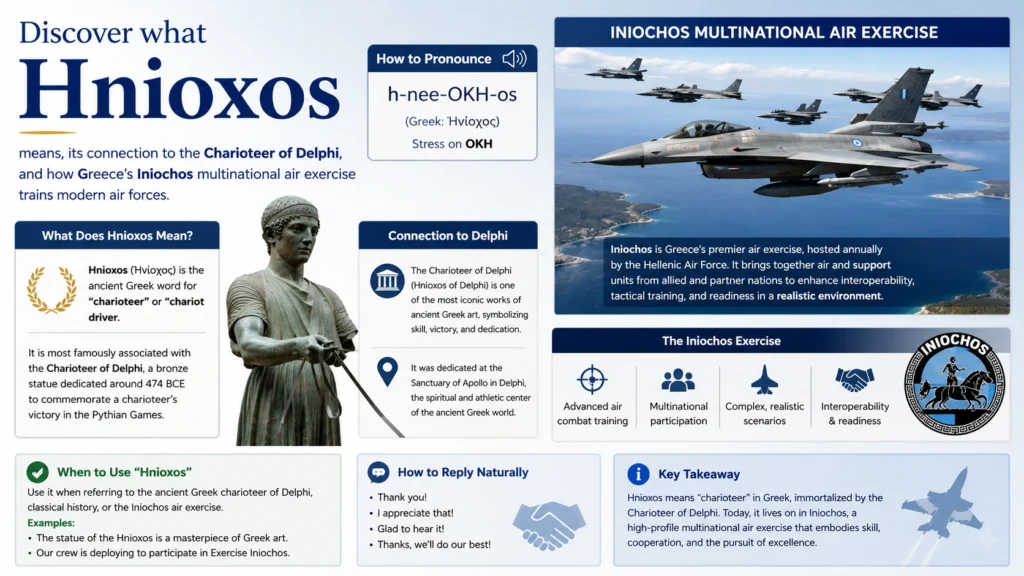
I see the keyword “hnioxos” as a doorway into two closely connected subjects. The first is an ancient Greek idea represented by the charioteer, a person responsible for controlling horses, maintaining direction, and responding calmly while moving at dangerous speed. The second is Exercise Iniochos, the multinational air warfare exercise organized by the Hellenic Air Force in Greece.
The spelling can initially make the subject confusing. A reader may encounter Hnioxos, Iniochos, Iniohos, or the original Greek word Ηνίοχος. These versions generally point toward the same underlying Greek term, although official English-language military sources normally use “Iniochos.” The Hnioxos spelling often appears when the visual form of the uppercase Greek word is represented with Latin characters.
In my analysis, the connection between the ancient and modern meanings is not accidental. A successful charioteer must coordinate several powerful forces without losing control. Modern air operations require a comparable combination of speed, awareness, discipline, communication, and precise decision-making. Exercise Iniochos takes that symbolic principle and applies it to multinational military aviation.
This article explains the meaning of hnioxos, the importance of the Charioteer of Delphi, the development of the Iniochos exercise, the types of missions participants conduct, and the practical reasons the exercise matters to Greece and its international partners.
Key Takeaways About Hnioxos
The following points provide a useful starting framework:
- Hnioxos comes from the Greek word Ηνίοχος, meaning a charioteer or a person who holds and controls the reins.
- The word is closely associated with the famous bronze Charioteer of Delphi.
- Official English-language military material usually spells the exercise name “Iniochos.”
- Exercise Iniochos began as a comparatively small Hellenic Air Force training event during the late 1980s.
- Greece transformed it into an international invitation exercise in 2015.
- The exercise is centered on the Air Tactics Center at Andravida Air Base.
- Participants train in complex air operations involving aircraft, ground-based defenses, maritime forces, electronic warfare, and special operations elements.
- Its central purposes include readiness, interoperability, tactical learning, mission planning, and realistic evaluation.
- Announced participant lists can change, so final completion reports are generally more reliable than preliminary announcements.
- The symbolic connection between the ancient charioteer and the modern exercise is control under pressure.
From my perspective, the most important lesson is that Hnioxos is not merely a military exercise name. It is a carefully chosen cultural symbol that communicates composure, coordination, and mastery over several moving forces.
What Does Hnioxos Mean?
Hnioxos refers to a charioteer, meaning the person who drives a horse-drawn chariot and controls the animals through the reins. The modern Greek form is ηνίοχος, and the word is associated with the concepts of holding, guiding, and directing the reins. A charioteer did much more than stand inside a moving vehicle. The role required balance, judgment, timing, physical control, and the ability to anticipate the movement of multiple horses.
The word can therefore be understood at two levels. At the literal level, it identifies a chariot driver. At the symbolic level, it represents someone who directs powerful forces while preserving order. That symbolic interpretation explains why the name works effectively for an advanced air exercise.
A charioteer could not rely on speed alone. Greater speed without control increased the possibility of collision, overturning, injury, or defeat. The driver had to understand the horses, the track, the competitors, the available space, and the precise moment to accelerate or change direction. In my view, the modern military parallel is clear: technology has value only when people can coordinate it intelligently.
Why the Spellings Hnioxos and Iniochos Both Appear
The original uppercase Greek spelling is ΗΝΙΟΧΟΣ. Several of its letters resemble Latin characters, which can produce the visually similar form HNIOXOS when someone reproduces the word without applying a formal transliteration system.
Official Hellenic Air Force and NATO English-language publications generally use “INIOCHOS.” Some Hellenic Air Force web addresses also use the variation “iniohos.” These differences do not normally indicate different exercises or concepts. They reflect alternative ways of representing Greek sounds and letters in the Latin alphabet.
For readers conducting research, I recommend treating Hnioxos as the target keyword while also searching for Iniochos. Searching only one version can omit official reports, historical archives, aviation articles, photographs, and military announcements filed under the other spelling.
How to Pronounce Hnioxos
The Greek pronunciation is approximately “ee-NEE-o-hos,” with the final “ch” or “h” sound produced more strongly than a typical English “h.” English speakers frequently simplify the pronunciation to “in-ee-oh-kos” or “in-ee-oh-hos.”
Exact pronunciation is less important than recognizing the relationship between the spellings. In written English, “Iniochos” remains the clearest choice when referring specifically to the Hellenic Air Force exercise because that is the spelling used by its organizers and NATO sources.
The Ancient Hnioxos and the Charioteer of Delphi
The most famous historical representation of an hnioxos is the Charioteer of Delphi, one of the best-preserved large bronze statues from ancient Greece. It dates from the early Classical period, generally around 480 to 470 BCE, and is displayed at the Archaeological Museum of Delphi.
The figure originally belonged to a much larger sculptural group. That composition included a four-horse chariot, the charioteer, and possibly additional figures. The surviving fragments help historians understand that museum visitors now see only one part of a much more elaborate victory monument.
The monument commemorated a victory connected with Polyzalus, a ruler from Sicily, at the Pythian Games. These games were held at Delphi and formed one of the major Panhellenic athletic and religious festivals of the ancient Greek world. The dedication linked athletic success with religious honor, public reputation, and political prestige.
The statue was buried after destruction in antiquity and was rediscovered during French excavations in 1896. Its survival is especially important because many ancient Greek bronze statues were later melted down. The Charioteer provides modern viewers with rare direct evidence of the technical and artistic quality achieved by Greek bronze workers.
READ: Bocche Lupo Meaning: The Correct Italian Phrase, Reply, Origin, and Usage
Why the Charioteer Looks Calm Instead of Triumphant
One of the statue’s most memorable features is its controlled expression. The young driver is not shown shouting, celebrating wildly, or displaying exaggerated physical movement. He stands upright with a composed face, a steady body, and a restrained sense of confidence.
I believe this composure is central to the statue’s continuing influence. The figure represents victory without loss of discipline. His calm appearance suggests that mastery is demonstrated through control rather than spectacle.
The sculptor also created a contrast between stillness and remembered movement. The surviving figure appears quiet, but the original scene involved horses, wheels, noise, risk, speed, and competition. The charioteer’s hand once held the reins connecting him to that energy. Even though much of the original monument is missing, viewers can still imagine the forces he was expected to command.
The official Delphi cultural site describes the figure as a timeless symbol of Delphi and emphasizes the tension visible in the hand that held the reins. It also notes the artistic treatment of the young winner’s gaze and body.
What the Ancient Hnioxos Symbolized
In ancient competition, the charioteer represented several qualities:
- Technical skill
- Courage under dangerous conditions
- Awareness of surrounding movement
- Physical discipline
- Rapid decision-making
- Responsibility for a team of horses
- Control of speed and direction
- Respect for the limits of equipment and terrain
These characteristics are useful outside chariot racing. A leader must guide people without suppressing their abilities. A pilot must manage speed, information, fuel, weapons, navigation, and communication. A project manager must coordinate resources while preventing one problem from destabilizing the entire plan.
For example, imagine a hypothetical logistics director handling several urgent deliveries during severe weather. The director cannot personally drive every vehicle or control every road. The task is to coordinate drivers, schedules, fuel, customer priorities, and changing conditions. That person functions metaphorically as an hnioxos by guiding several forces toward a common objective.
How Hnioxos Became the Name of an Air Exercise
The Hellenic Air Force began Exercise Iniochos in the late 1980s as a relatively small tactical training exercise. It was initially designed to improve the ability of Greek fighter squadrons to conduct composite air operations under realistic conditions.
Composite air operations bring together aircraft with different capabilities and responsibilities. A mission package may include fighters providing air defense, strike aircraft attacking targets, surveillance platforms building situational awareness, tankers extending aircraft endurance, helicopters supporting recovery operations, and electronic warfare assets interfering with hostile sensors.
Naming the exercise after the charioteer creates a powerful analogy. The exercise leadership must direct many units, aircraft types, mission objectives, airspaces, and threat systems. Participating crews must control advanced machines while processing information at high speed. Every part must remain connected to the larger mission.
The symbolism also reflects the relationship between power and restraint. A modern combat aircraft can travel quickly and carry sophisticated sensors or weapons, but operational success depends on planning, identification, timing, rules, communication, and coordination. Raw performance does not automatically produce an effective mission.
A statement highlighted in the Joint Air Power Competence Centre’s history of the exercise captures its intended character:
“Increasing realism, combat readiness, and sharing knowledge are the core values of ‘Iniochos’.”
Colonel Konstantinos Zolotas, Joint Air Power Competence Centre
This quotation matters because it identifies three distinct goals. Realism tests whether procedures work under pressure. Combat readiness measures whether units can perform assigned tasks. Knowledge sharing ensures that participating forces learn from one another instead of simply operating in the same airspace.
How Exercise Iniochos Developed
The exercise did not become a major multinational event immediately. It evolved through changes in basing, command structure, scenario design, evaluation methods, and international participation.
During its early period, Iniochos was primarily a national Hellenic Air Force exercise. Aircraft could operate from their home bases or from separate deployed locations. Planning and command responsibilities were therefore distributed across several facilities.
In 2013, organizers adopted the Single Base Operations concept. This brought much of the exercise activity together at Andravida Air Base, where the Hellenic Air Force Air Tactics Center is located. The revised arrangement allowed organizers to create a more concentrated operational tempo, strengthen direct coordination, and conduct detailed common briefings and debriefings.
The concept was tested in a national format in 2014. In 2015, the exercise became an invitation exercise, commonly described by the abbreviation INVITEX. International forces could then deploy personnel and aircraft to train alongside Greek units. Early foreign involvement included forces from Israel and the United States.
Major Stages in the Development of Hnioxos
The table shows how the exercise moved from a domestic tactical event to an internationally recognized training environment.
| Period | Main Development | Practical Significance |
|---|---|---|
| Late 1980s | Iniochos begins as a small Hellenic Air Force tactical exercise | Greek fighter units receive structured training in composite air operations |
| Before 2013 | Operations are distributed across home and deployed bases | Units gain experience coordinating missions across several locations |
| 2013 | Single Base Operations concept is adopted | Planning, flying, support, and evaluation become more concentrated |
| 2014 | Revised format is tested as a Hellenic Air Force exercise | Organizers validate the expanded structure before international participation |
| 2015 | Iniochos becomes an international invitation exercise | Allied and partner air forces begin deploying aircraft and personnel |
| 2016 onward | Scenarios increasingly integrate air, land, maritime, and non-physical domains | Training reflects the complexity of modern joint operations |
| 2020s | Participation, aircraft diversity, and international visibility expand | The exercise becomes an important European and Mediterranean training event |
| 2026 | The exercise runs from March 9 to March 20 | Greece continues the annual multinational format with foreign and domestic assets |
The central change was not simply an increase in the number of aircraft. The exercise became more integrated. Participants now work within a shared campaign, face coordinated threats, respond to changing information, and receive detailed mission evaluation.
How Hnioxos Training Works in Practice
Exercise Iniochos is built around an operational scenario rather than a collection of unrelated demonstration flights. Organizers create a fictional crisis that develops into a larger conflict. Mission objectives are then connected to the progress of that campaign.
A mission conducted during the morning may affect the assumptions used during a later mission. Participants may receive new intelligence, face an unexpected defensive system, lose access to a planned route, or be assigned a time-sensitive objective. This structure encourages crews and planners to think beyond the performance of an individual aircraft.
The Joint Air Power Competence Centre has described the exercise design as adaptable, using a “chameleon” concept that changes according to military developments, projected threats, participant feedback, and lessons from previous editions.
That adaptability is important because military aviation does not remain static. Sensors improve, electronic warfare systems change, unmanned platforms become more common, air defenses become more capable, and communication networks become more contested. Repeating the same scenario every year would gradually reduce the exercise’s value.
Planning Before a Mission
A complex mission begins long before aircraft take off. Planners must understand the objective, available assets, expected opposition, airspace restrictions, weather, fuel requirements, communication procedures, emergency options, and rules governing the mission.
Different aircraft are assigned responsibilities according to their strengths. One formation may suppress air defenses. Another may provide protection against hostile fighters. A surveillance aircraft may supply a broader operational picture. A tanker may be positioned to extend mission duration. A rescue element may remain prepared to respond if a crew must abandon an aircraft.
The planning team must also decide how these elements will move through the same airspace without creating confusion or unacceptable risk. Timing becomes critical. An aircraft arriving several minutes early or late may lose the protection provided by another unit.
Execution Under Pressure
Once the mission begins, crews must adapt to simulated opposition and new information. The exercise uses challenging threat presentations, including air-to-air adversaries and ground-based defensive systems. Participants may operate over high terrain, coastal areas, and open sea within the Athens Flight Information Region.
NATO Allied Air Command summarized the scale and difficulty of the latest edition with a direct description:
“One of the most complex and realistic multi-domain air exercises in Europe and the Mediterranean.”
NATO Allied Air Command, describing Iniochos 2026
The reference to multiple domains is significant. Modern operations are not divided neatly into isolated air, land, and maritime activities. Aircraft may support ground forces, protect ships, gather intelligence, respond to electronic interference, or coordinate with special operations personnel.
Debriefing and Mission Reconstruction
The debrief is one of the most valuable parts of the exercise. Pilots may feel that a mission succeeded, but perception from the cockpit is incomplete. Organizers therefore reconstruct mission events using information from onboard sensors, offboard systems, positioning data, tactical data links, and specialized assessment software.
Instructors can examine when a threat was detected, how a formation responded, whether communication remained clear, whether simulated weapons were used effectively, and whether the mission package maintained coordination.
This process turns an exciting flight into a measurable learning event. Without detailed evaluation, participants might repeat the same mistakes because they never receive a complete picture of what happened.
A Hypothetical Hnioxos Mission Scenario
Consider a fictional training scenario in which a multinational force must protect a maritime route while striking a hostile radar installation.
The mission package includes defensive fighters, strike aircraft, a surveillance platform, a tanker, an electronic warfare element, and a rescue helicopter. Ground-based air defenses protect the target, while opposing fighters attempt to intercept the strike group.
Before departure, the planners create a route that avoids the strongest threat areas. The defensive fighters are assigned to protect the strike formation. Electronic warfare support is scheduled to reduce the effectiveness of hostile radar. The tanker is positioned far enough from the simulated conflict to remain protected but close enough to support aircraft returning with low fuel.
During the mission, the original route becomes unavailable because a mobile air defense system appears in the area. The package commander must decide whether to change direction, delay the strike, request additional support, or accept greater risk.
At the same time, a simulated hostile aircraft approaches the tanker. Some defensive fighters must turn away from the strike group to protect that high-value asset. The strike aircraft now have less protection and must reconsider their timing.
This example illustrates why Iniochos is not simply about pilot skill. Success depends on shared awareness, disciplined communication, flexible planning, and an understanding of how one decision affects the rest of the force.
Missions Practiced During Exercise Iniochos
The exercise can include a broad selection of mission categories. The exact combination changes according to the annual scenario, available participants, safety requirements, and training objectives.
Iniochos Mission Types and Their Purposes
Readers should compare not only what each mission does but also how it contributes to the larger campaign.
| Mission Type | Primary Purpose | Practical Training Value |
|---|---|---|
| Offensive Counter Air | Reduce an opposing force’s ability to operate aircraft | Trains coordinated attacks against airfields, aircraft, and supporting systems |
| Defensive Counter Air | Protect friendly territory and forces from air attack | Develops interception, surveillance, identification, and defensive coordination |
| Air Interdiction | Attack targets before they can affect friendly ground forces | Improves target prioritization, timing, navigation, and strike coordination |
| Suppression of Enemy Air Defenses | Temporarily limit hostile air defense effectiveness | Helps aircraft operate in defended airspace |
| Destruction of Enemy Air Defenses | Permanently remove selected defensive systems | Requires intelligence, targeting, specialized tactics, and coordinated protection |
| Close Air Support | Support friendly personnel near hostile forces | Demands precise communication and careful identification |
| Combat Search and Rescue | Recover personnel from a hostile or contested environment | Integrates helicopters, fighters, surveillance, and ground teams |
| Dynamic Targeting | Respond to targets discovered after a mission has begun | Tests rapid decision-making and information sharing |
| Maritime Strike or Interdiction | Engage or restrict hostile activity at sea | Connects air operations with naval awareness and maritime objectives |
| High-Value Airborne Asset Protection | Defend tankers, surveillance aircraft, or command platforms | Teaches participants to protect assets that support the entire force |
| Tactical Reconnaissance | Collect information about threats, movement, or targets | Supports later decisions and helps commanders update the operational picture |
| Electronic Warfare | Disrupt, deceive, detect, or protect electronic systems | Trains forces to operate when sensors and communications are contested |
The table demonstrates why a multinational exercise is useful. Few participating countries can reproduce every required aircraft, threat system, geographic condition, and mission role independently. Combining assets creates training opportunities that would otherwise be difficult or expensive to arrange.
Why Andravida Air Base Is Central to Hnioxos
Andravida Air Base is located in the western Peloponnese and hosts the Hellenic Air Force Air Tactics Center. The center was formed in 1983 and is responsible for advanced tactical education and exercise activity.
The location allows access to varied training environments. Missions can involve mountainous terrain, coastal routes, islands, and open water. This variety forces crews to adjust navigation, altitude, communication, sensor use, and threat responses.
High terrain can restrict radar visibility and create narrow routing options. Coastal areas require crews to distinguish land and maritime activity. Open sea provides space for larger formations but can complicate visual reference and recovery planning.
The Hellenic Air Force can also combine the exercise with land, naval, air defense, and special operations elements. This makes Andravida more than a runway used to launch aircraft. It becomes the central point of a broader operational network.
The Single Base Operations model offers additional advantages. Crews from different countries can attend shared briefings, speak directly with planners, compare procedures, and participate in common debriefs. Maintenance teams and support personnel also learn how to operate within a busy international environment.
What Interoperability Means During Hnioxos
Interoperability is often described as the ability of different forces to operate together effectively. In practice, that involves many small but essential details.
Aircraft crews must use compatible communication procedures. Planners must understand how another country describes threats and targets. Tanker crews must coordinate refueling procedures with visiting aircraft. Ground personnel must handle equipment, security, movement, and emergency requirements for several aircraft types.
Language is another factor. English may be used as the common operational language, but participants can still interpret abbreviations, instructions, or priorities differently. Exercises reveal these differences before they become problems during a real operation.
Interoperability also involves trust. A pilot must believe that another formation will arrive at the agreed time. A strike package must trust the surveillance information it receives. A rescue team must understand what protection will be available.
The Indian Ministry of Defence explained this practical value when discussing its participation in the 2025 exercise:
“Hone their skills, exchange tactical knowledge, and strengthen military ties.”
Indian Ministry of Defence
I think the phrase “exchange tactical knowledge” deserves particular attention. An exercise is not only a test in which one participant proves superiority. It is also an environment where different forces observe alternative methods, compare assumptions, and identify practices that may improve their own operations.
Hnioxos 2025 and 2026
Recent editions demonstrate both the international reach of the exercise and the possibility of significant year-to-year variation.
Iniochos 2025 ran from March 31 to April 11 at Andravida Air Base. Participating aircraft and support assets represented a diverse group that included Greece, France, India, Israel, Italy, Montenegro, Poland, Qatar, Slovenia, Spain, the United Arab Emirates, and the United States. India deployed Su-30MKI fighters supported by IL-78 and C-17 aircraft, while other contingents contributed fighters, helicopters, surveillance aircraft, electronic warfare platforms, and tankers.
The range of aircraft mattered because it allowed participants to train with platforms that have different performance characteristics, sensors, weapons roles, and operating procedures. Familiarity with these differences can reduce uncertainty during future coalition activity.
Iniochos 2026 began on March 9 and concluded on March 20. The Hellenic Air Force’s completion summary identified foreign participation from France with Mirage 2000D aircraft, Slovenia with PC-9 aircraft, and Albania with AS-532 helicopters. Greek forces participated with a broader collection of domestic air, land, naval, and special operations assets.
The difference between editions provides an important research lesson. Preliminary reports may describe a larger planned roster than the group that ultimately deploys. Operational commitments, maintenance, diplomatic decisions, security developments, and logistical restrictions can change participation.
For this reason, I recommend using the final Hellenic Air Force completion report when identifying who actually participated. An announcement published before the exercise is useful for understanding the plan, but it should not automatically be treated as proof of final attendance.
How to Research Hnioxos Step by Step
A reader researching hnioxos can avoid considerable confusion by following a structured process.
Step 1: Search Both Hnioxos and Iniochos
Begin with the exact keyword “hnioxos,” but repeat the search using “Iniochos.” Add a year when researching a particular edition, such as “Iniochos 2026” or “Iniochos 2025.”
This approach separates the broad Greek meaning from information about the military exercise. It also reduces the chance of missing official pages that use a different transliteration.
Step 2: Identify the Subject of Each Result
Determine whether the page concerns:
- The Greek word for charioteer
- The Charioteer of Delphi
- The Hellenic Air Force exercise
- A business, artwork, film, organization, or product using the name
- An unrelated term such as NixOS
A search result containing the keyword is not automatically relevant to the intended subject.
Step 3: Prioritize Official Sources
For exercise dates, participants, objectives, and completion information, begin with:
- The Hellenic Air Force
- NATO Allied Air Command
- Government defense ministries of participating countries
- Official military press releases
- Established research or professional air power organizations
Aviation publications can provide valuable photographs and aircraft details, but official sources should anchor the main factual account.
Step 4: Compare Publication Dates
Check when a page was published and what stage of the exercise it describes. A January registration announcement, a March opening report, and a completion report may all contain different information.
The latest page is not always the most useful. A later photo gallery may repeat preliminary data, while an earlier official completion report may provide the clearest final roster.
Step 5: Separate Planned and Confirmed Participation
Look for language such as “scheduled to participate,” “expected,” “announced,” “deployed,” “participated,” or “completed.”
These terms are not interchangeable. “Scheduled to participate” describes an intention. “Participated” indicates that the force was present according to the reporting source.
Step 6: Distinguish Aircraft Presence From Full Participation
A country can be involved in several ways:
- Deploying combat aircraft
- Supplying transport or tanker support
- Sending helicopters
- Contributing special operations personnel
- Providing ground controllers
- Sending observers
- Participating in planning without deploying aircraft
A simple country count can therefore conceal important differences.
Step 7: Confirm Technical Claims
Aircraft variants, sortie numbers, weapons, and mission roles should be verified before publication. Aviation enthusiasts often provide detailed reporting, but unofficial sources may disagree about variants or unit assignments.
When official confirmation is unavailable, describe the detail as reported rather than presenting it as certain.
Common Mistakes When Interpreting Hnioxos
Treating Hnioxos as the Only Correct Spelling
Hnioxos is understandable as a keyword, but Iniochos is the standard spelling used in official English-language military coverage. A writer who refuses to use the official variation will make the article harder to verify and may confuse readers.
A practical solution is to use hnioxos naturally in the title and opening while explaining that Iniochos is the official exercise spelling.
Confusing Iniochos With an Air Show
Iniochos is primarily an operational training exercise, not a public entertainment event. Organizers may arrange a distinguished visitors day, media access, or a spotters day, but those activities represent only a limited public-facing portion of the exercise.
The main purpose is to train crews, planners, controllers, support teams, and commanders in demanding scenarios.
Focusing Only on Fighter Aircraft
Fighter aircraft attract the most attention in photographs, but the exercise depends on many other elements. Tankers, surveillance aircraft, transport aircraft, helicopters, air defense units, naval forces, ground forces, special operations personnel, controllers, maintenance teams, and intelligence staff can all contribute.
A mission package without support assets may have limited range, reduced awareness, or no recovery option. In my view, the less visible participants often explain how the exercise functions.
Assuming Every Country Uses the Same Procedures
International forces may share NATO standards or common terminology, but equipment, national rules, training backgrounds, and decision-making processes still differ.
One of the exercise’s purposes is to reveal and manage those differences. Complete uniformity is not required. Effective coordination is the real objective.
Treating Exercise Outcomes as Proof of Combat Superiority
Public exercise reports usually describe objectives, participation, and broad achievements. They rarely provide enough evidence to rank pilots, aircraft, or national forces objectively.
Performance depends on assigned roles, scenario rules, threat assumptions, restrictions, and information that may not be public. Claims that one aircraft “defeated” another during a training event should therefore be treated cautiously unless the organizers provide sufficient context.
Using Preliminary Participant Lists as Final Evidence
Planned attendance can change shortly before or during the event. A reliable article should identify whether its participant information comes from an announcement or a completion report.
This distinction became especially relevant in 2026, when the final Hellenic Air Force summary identified a smaller foreign aircraft group than several preliminary reports had suggested.
Expert Recommendations for Understanding Hnioxos
My first recommendation is to study the exercise as a system rather than as a collection of aircraft. Individual platforms matter, but the central challenge is coordinating them. Ask how information moves, how decisions are made, how threats are represented, and how mission results are evaluated.
Second, consider the historical meaning of the name. The Charioteer of Delphi is not remembered because he possessed the strongest horse. He is remembered as the figure capable of directing power with discipline. That concept provides a better explanation of Iniochos than a simple list of fighter types.
Third, separate technical training value from political interpretation. Multinational participation can strengthen diplomatic relationships, but each country may have different reasons for attending. Some seek experience with unfamiliar aircraft. Others want to practice long-distance deployment, tanker support, electronic warfare, or coalition planning.
Fourth, recognize the value of debriefing. The most important learning may occur after the aircraft land. A reconstructed mission can reveal communication delays, planning assumptions, missed threats, fuel problems, or timing errors that were invisible to individual crews.
Fifth, maintain perspective when discussing realism. An exercise can reproduce pressure, uncertainty, complex threats, and operational tempo, but it cannot duplicate every consequence of actual conflict. Training realism is valuable precisely because it creates difficulty within a controlled and assessable environment.
Why Hnioxos Matters Beyond Greece
Iniochos matters to Greece because it strengthens domestic readiness while demonstrating the capabilities of the Hellenic Air Force and the Air Tactics Center. It also allows Greek crews to train with international platforms that may not be available during national exercises.
For visiting forces, Greece provides challenging geography and access to a sophisticated multinational scenario. Participants can practice deployment, maintenance, mission planning, refueling, command coordination, and tactical execution away from their normal operating locations.
The exercise also supports relationships among countries from Europe, the Mediterranean, the Middle East, Asia, and North America. Participation does not mean that every country shares the same political position on every issue. It does show that their forces see practical value in communication and coordinated training.
Military exercises can also function as a form of signaling. They demonstrate readiness, partnerships, access, and the ability to assemble a multinational force. However, I believe responsible analysis should avoid treating every exercise as preparation for one specific conflict. Iniochos has a broader training purpose and uses adaptable fictional scenarios.
Its lasting importance comes from repetition. One event can create temporary familiarity. Annual or recurring training allows planners to apply lessons, update scenarios, introduce new systems, and deepen working relationships.
The Broader Symbolism of Hnioxos
The hnioxos metaphor remains relevant because modern organizations struggle with the same basic problem faced by the ancient charioteer: how can several powerful elements be guided toward one objective without losing stability?
In aviation, the forces include aircraft performance, sensors, weapons, fuel, weather, terrain, communications, and human judgment. In business, they may include people, budgets, deadlines, technology, and customer expectations. In public policy, they include institutions, laws, competing interests, and limited resources.
The answer is not maximum control over every individual movement. A charioteer cannot carry the horses around the track. The driver establishes direction, maintains connection, senses changes, and intervenes at the correct moment.
This distinction offers a practical leadership lesson. Excessive control can slow a team and suppress expertise. Insufficient control can cause fragmentation. Effective leadership creates enough structure to maintain direction while allowing skilled participants to perform their roles.
A hypothetical emergency response team provides a useful example. Medical personnel, firefighters, police officers, and logistics staff have different responsibilities. One commander should not attempt to perform every task personally. The commander’s role is to establish priorities, coordinate information, remove conflicts, and ensure that each specialist supports the same objective.
That is the enduring value of the hnioxos image. It represents disciplined coordination rather than domination for its own sake.
Conclusion
I believe the clearest way to understand hnioxos is to connect its ancient meaning with its modern application. The word identifies a charioteer, but it also represents the ability to guide speed, power, risk, and movement without losing direction. The Charioteer of Delphi expresses that idea through calm physical control, while Exercise Iniochos applies it to multinational air operations.
The exercise has developed from a small Hellenic Air Force training event into an adaptable international environment involving complex missions, shared planning, demanding threat scenarios, and detailed debriefing. Its value does not come only from the number or appearance of participating aircraft. It comes from the opportunity to discover whether different crews, platforms, and support systems can operate as one coordinated force.
For readers researching Hnioxos, my practical recommendation is to search both major spellings, prioritize official completion reports, distinguish planned attendance from confirmed participation, and examine the supporting mission structure rather than focusing only on fighter aircraft.
The next useful step is to compare a recent Hellenic Air Force completion report with the exercise’s historical description. That comparison shows how the ancient principle of controlled power continues to shape a modern training system.
Frequently Asked Questions
What Does Hnioxos Mean in English?
Hnioxos means “charioteer” in English. It refers to a person who drives a chariot and controls the horses by holding the reins. The term comes from Greek and carries a broader symbolic meaning involving direction, discipline, balance, and control under pressure. In modern military usage, the name is associated with the Hellenic Air Force’s Iniochos exercise. The connection is appropriate because multinational air operations require someone to coordinate several fast-moving and powerful elements toward a common objective.
Are Hnioxos and Iniochos the Same Thing?
Hnioxos and Iniochos usually refer to the same underlying Greek word, Ηνίοχος. Hnioxos reflects a visual or alternative Latin rendering, while Iniochos is the spelling normally used by the Hellenic Air Force and NATO in English-language material. When researching the subject, using both spellings produces better results. “Hnioxos meaning” is useful for cultural and linguistic information, while “Iniochos exercise” is more effective for finding official military reports, annual archives, participation details, and exercise dates.
What Is Exercise Iniochos?
Exercise Iniochos is a multinational air training exercise hosted by the Hellenic Air Force and centered on the Air Tactics Center at Andravida Air Base. It uses realistic campaign scenarios to train aircrews and supporting forces in mission planning, execution, communication, tactical adaptation, and debriefing. Activities can involve offensive and defensive air missions, air defense suppression, dynamic targeting, combat search and rescue, maritime operations, electronic warfare, and protection of high-value support aircraft.
Where Does the Hnioxos Exercise Take Place?
The exercise is primarily based at Andravida Air Base in the western Peloponnese region of Greece. Aircraft operate across designated training areas within the Athens Flight Information Region. Greece’s combination of mountains, coastline, islands, and open sea supports varied tactical scenarios. The Air Tactics Center at Andravida provides the planning, instructional, and evaluation structure needed for the exercise. Other Greek military facilities and forces may also contribute depending on the annual scenario and participating assets.
Is Iniochos Held Every Year?
The Hellenic Air Force describes Iniochos as an annual medium-scale invitation exercise. Individual reports from participating countries have occasionally used different wording, so the organizer’s description should be treated as the primary reference. The dates change each year, and the participating countries and aircraft types can also vary. Iniochos 2025 took place from March 31 to April 11, while Iniochos 2026 ran from March 9 to March 20.
Which Countries Participate in Hnioxos?
Participation changes from one edition to another. Previous exercises have involved forces from Greece, France, India, Israel, Italy, Montenegro, Poland, Qatar, Slovenia, Spain, the United Arab Emirates, the United States, and other allied or partner countries. Some nations deploy combat aircraft, while others contribute helicopters, surveillance platforms, tankers, special operations personnel, support teams, or observers. Final completion reports should be checked because preliminary participant announcements may change before the exercise ends.
Is the Charioteer of Delphi Connected to the Exercise Name?
Yes. The exercise name refers to the ancient Greek charioteer and is closely associated with the Charioteer of Delphi. The statue presents a controlled and composed driver who once formed part of a four-horse chariot monument. The symbolic connection emphasizes the ability to guide multiple powerful forces while maintaining awareness and discipline. That image fits a complex air exercise in which commanders, planners, pilots, controllers, and support personnel must coordinate different assets under pressure.
Can Members of the Public Watch Exercise Iniochos?
The exercise itself is a military training activity and is not generally open to unrestricted public viewing. However, the Hellenic Air Force may organize a spotters day, media day, or distinguished visitors event during a particular edition. Access normally requires advance registration and compliance with security instructions. Public arrangements can change each year, so readers should rely on current Hellenic Air Force announcements rather than assuming that access offered during a previous edition will be available again.
Sources and References
- Hellenic Air Force, official history and description of Exercise Iniochos.
- Hellenic Air Force, Iniochos 2025 archive and participation information.
- Hellenic Air Force, Iniochos 2026 completion information.
- NATO Allied Air Command, coverage of Iniochos 2024 and 2026.
- Joint Air Power Competence Centre, history and operational analysis of Iniochos.
- Archaeological Site of Delphi, official information about the Charioteer of Delphi.
- Indian Ministry of Defence, Indian Air Force participation in Iniochos 2025.
Disclaimer
This article is intended for general educational and informational purposes. Exercise dates, participant lists, aircraft deployments, public-access arrangements, and military activities can change because of operational, diplomatic, safety, or logistical requirements. Readers should consult current Hellenic Air Force, NATO, and participating government announcements before relying on details about a future or ongoing edition of Exercise Iniochos.