
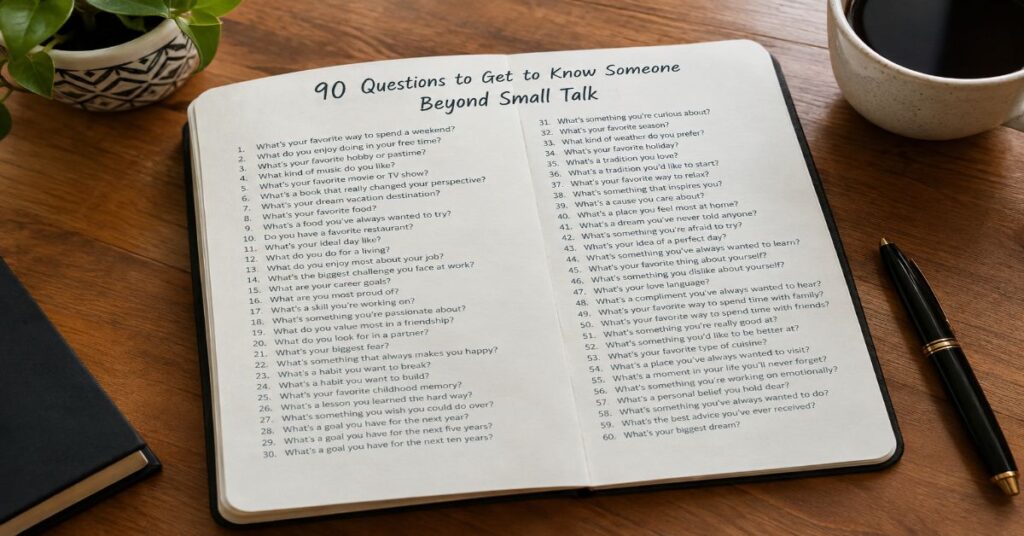
I think the best questions to get to know someone do two jobs at once: they reveal something real and make the other person feel safe enough to keep talking. That is why a sharp follow-up often matters more than the cleverness of the first prompt. Research on question-asking links responsive follow-ups with greater interpersonal liking, while research on deeper conversations suggests people often expect more awkwardness than they actually experience (Huang et al., 2017; Kardas et al., 2022).
This guide is built around that tension. You want to learn more without sounding like an interviewer, get past small talk without jumping straight into someone’s private history, and keep the exchange mutual. The 90 prompts below move from easy openings to stories, values, deeper topics, dating, friendship, work, online chats, and entertainment. A favorite movie can be a low-pressure doorway too. If horror is common ground, our best horror movies of 2026 can turn a generic “What do you watch?” into a specific conversation about taste, fear, and memorable scenes.
The goal is not to finish the list. It is to notice the answer that contains a thread, then follow it. If the other person lights up, gives detail, asks you something back, or introduces a personal story, you can usually go one level deeper. If answers get shorter, guarded, or purely factual, stay lighter and change direction.
The 1-1-1 Conversation Loop: Ask, Follow Up, Share
Real conversation works better as a loop than a checklist. Our 1-1-1 method is simple: ask one useful question, ask one follow-up based on the answer, then share one related detail of your own.
Why the Follow-Up Matters
Ask what part of the week they are looking forward to. If they mention a sibling’s visit, ask what they enjoy doing together, then share a short related detail of your own. That follow-up proves you heard the answer and gives the other person something back.
Huang and colleagues linked follow-up questions with greater liking in live conversations. A 2025 correction fixed minor reporting errors while retaining the paper’s overall conclusions. A published critique challenged the speed-dating analysis, so the practical takeaway is not “ask more at all costs.” It is to ask responsively and adapt to the person (Kluger & Malloy, 2019).
Let the Answer Set the Depth
Do not increase intimacy just because a list labels the next prompt “deep.” Match the depth of your next question to the depth of the answer you just received.
Choose the Right Depth Before You Ask
Context changes the job of a question. A prompt that fits a partner may be intrusive with a coworker, while a silly hypothetical can help a quiet group but feel evasive in a serious talk.
| Relationship stage | Best question style | Good sign to go deeper | Signal to stay light |
| Just met | Low-stakes preferences and current experiences | They add detail, laugh, or ask you back | One-word replies or repeated topic changes |
| New acquaintance | Stories about routines, places, interests, and choices | They explain why something matters | Answers stay factual or guarded |
| Growing friendship or early dating | Values, ambitions, boundaries, formative experiences | They reflect or ask for your view | They hedge or decline the topic |
| Established trust | Fears, regrets, identity, conflict, future plans | They name emotions or nuance | Tension rises or privacy is poor |
Reciprocity is the clearest signal. If they answer with energy and ask you something back, continue. If you are doing all the asking, pause and share something instead.
90 Questions to Get to Know Someone
Use the section that matches the setting. You do not need to move in order, and you do not need to ask every question. Pick one that feels natural, listen for the interesting detail, and follow that detail before returning to the list.
Easy Questions for Someone New
1. What has been the best part of your week so far?
2. What is something you are looking forward to right now?
3. How do you usually spend a free evening?
4. What kind of food can almost always improve your mood?
5. What is a place you would happily visit again?
6. What is one small thing that makes your day easier?
7. Are you more of a plan-ahead person or a decide-on-the-day person?
8. What is something you have been listening to a lot lately?
9. What is a hobby you wish you had more time for?
10. What does your ideal slow morning look like?
Streaming can also give a new conversation an immediate shared reference point. If both of you watch current releases, use our Amazon Prime new releases coverage to pick a title, then ask what usually makes someone press play in the first place.
Questions That Invite a Story
11. What is a trip or day out that turned out better than you expected?
12. What is a childhood habit you somehow still have?
13. Who taught you something you still use all the time?
14. What is a mistake that became a good story later?
15. What is the most spontaneous thing you have done recently?
16. What was your favorite place to spend time when you were younger?
17. What is a tradition you would like to keep for the rest of your life?
18. What is a compliment you still remember?
19. When did you last surprise yourself?
20. What is a job, class, or project that changed how you think?
Questions About Personality and Values
21. What quality do you value most in a friend?
22. What usually makes you trust someone?
23. What kind of behavior makes you lose respect for a person?
24. What does a good life look like to you right now?
25. When do you feel most like yourself?
26. What do people often misunderstand about you?
27. What is something you have changed your mind about in the last few years?
28. What does success mean to you outside of money or status?
29. What boundary took you time to learn?
30. What kind of apology feels sincere to you?
Deeper Questions for Trust-Building
31. What is a fear you understand better now than you did five years ago?
32. What is something you are still learning to forgive yourself for?
33. What kind of support helps you most when you are overwhelmed?
34. What is a hard lesson that genuinely changed your behavior?
35. When do you find it hardest to ask for help?
36. What is something you wish people asked you about more often?
37. What is a part of adulthood you were not prepared for?
38. What is one belief about yourself you are trying to update?
39. What does feeling emotionally safe with someone mean to you?
40. What is a regret that taught you something useful?
Questions for a Date or Partner
41. What makes a date feel easy rather than performative to you?
42. What kind of affection do you notice most?
43. What does quality time look like in a relationship for you?
44. How do you prefer to handle disagreements?
45. What is a relationship green flag you think is underrated?
46. What helps you feel close to someone over time?
47. How important is independence inside a relationship to you?
48. What is something you think couples should talk about earlier than they usually do?
49. What makes you feel chosen or prioritized?
50. What does commitment mean to you in practice?
If the last dating question turns into date-night planning, our guide to thrillers on Netflix India gives you a specific set of films to compare before you ask which kind of suspense they actually enjoy.
Questions for Friends and Family
51. What is a memory of us that you think I remember differently?
52. What has changed most about you since we first met?
53. What is something you think our family or friend group does really well?
54. What is a tradition you would like us to start?
55. What is something you wish we did together more often?
56. What kind of support from friends feels most useful to you?
57. Who in your family shaped your sense of humor?
58. What story from your family gets told over and over?
59. What is something you learned from a friendship that ended?
60. What makes you feel close to a friend even after time apart?
Questions for Coworkers and Groups
61. What part of your work gives you the most energy?
62. What is a skill you use at work that people rarely notice?
63. What is the best advice a coworker or mentor has given you?
64. What kind of project makes time pass quickly for you?
65. What is something outside work you are excited to learn?
66. What is your favorite way to reset after a busy day?
67. What is one professional habit you are trying to improve?
68. What makes a team feel good to work with?
69. What is a job you had that taught you more than you expected?
70. What is something people in your field often get wrong about it?
Questions for Texting and Online Chats
71. What is something you can explain much better by text than in person?
72. What is the last link or post you sent to someone because it reminded you of them?
73. What kind of message makes you reply immediately?
74. Do you prefer voice notes, calls, or text when a conversation gets long?
75. What is an online community or creator you genuinely enjoy?
76. What is a topic you can easily lose an hour reading about online?
77. What is the funniest message you have received recently?
78. What is one digital habit you would like to change?
79. What makes an online conversation feel personal rather than generic?
80. When do you know it is time to move a chat from text to a call or in-person conversation?
Movie and Entertainment Questions
Entertainment questions work well because disagreement can stay playful. If awards-season opinions come up, the Oscars 2026 winners and nominees list gives both people a factual starting point before the conversation shifts to taste, performances, and surprise wins.
81. What movie have you recommended more than any other?
82. Which film scared you more than you expected?
83. What movie would you erase from memory just to watch fresh again?
84. Which actor can usually convince you to try a film?
85. What is your favorite terrible movie?
86. Which fictional world would you actually want to spend a week in?
87. What film ending have you argued about the most?
88. Would you rather watch a new release or rewatch a comfort favorite?
89. Which movie soundtrack can change your mood immediately?
90. What film do you think deserved more attention?
What the Research Says About Better Conversations
Research does not identify a magic list. It points instead to responsiveness, gradual disclosure, and time. A prompt can start a conversation, but it cannot replace what happens after the answer.
| Evidence | What the study found | Practical implication | Important caveat |
| Huang et al., 2017 | Follow-up questions were linked with greater liking in live conversations. | Follow the answer instead of switching topics. | A 2025 correction retained the overall conclusions. |
| Kluger & Malloy, 2019 | A reanalysis challenged the speed-dating interpretation and emphasized dyad effects. | Do not treat question count as a score. | The critique targets the field-study interpretation. |
| Kardas et al., 2022 | Strangers expected deep talks to be more awkward than they proved to be. | Slightly deeper talk may work when signals are positive. | Depth should remain voluntary and contextual. |
| Aron et al., 1997 | An escalating 45-minute disclosure procedure increased closeness versus small talk in one study. | Increase depth gradually. | The experiment is not a guaranteed intimacy formula. |
| Hall, 2019 | Time together and everyday talk tracked friendship development; close friendship estimates exceeded 200 hours. | Questions cannot replace repeated time together. | The estimates are patterns, not deadlines. |
Jeffrey Hall summarized the time problem plainly: “You can’t snap your fingers and make a friend.” Better prompts can help, but trust still grows through repeated contact, shared experience, and reliability (Hellman, 2018; Hall, 2019).
Common Mistakes That Make Good Questions Feel Awkward
Turning the list into an interview
If you ask three unrelated questions in a row without reacting to the answers, the other person can start to feel assessed. Use the 1-1-1 loop and let one answer create the next topic.
Confusing depth with intimacy
A vulnerable question is not automatically a meaningful question. Depth works best when the setting is private enough, the relationship can hold it, and the other person has an easy way to decline.
Asking what you would not answer yourself
Reciprocity matters. If a topic feels too exposed for you to discuss, it is usually unfair to demand that level of openness from someone else.
Using “why” when curiosity sounds like judgment
“Why did you do that?” can sound prosecutorial. Softer alternatives such as “What was going through your mind then?” or “What made that choice feel right?” often leave more room for nuance.
Ignoring the exit signals
Shorter answers, repeated jokes, a sudden phone check, or a direct “I would rather not get into that” are enough. Change the subject without making the person defend the boundary.
The Future of Getting-to-Know-You Questions in 2027
By 2027, conversation tools are likely to become more contextual rather than simply longer. In 2026, dedicated sites already sort prompts by relationship stage, setting, and depth, and some market interactive or AI-assisted experiences. Reliable adoption data is not public, so that forecast remains directional. The durable advantage will still be human judgment: knowing when a question fits, when a follow-up is earned, and when to stop.
Key Takeaways
- Specific questions usually create better stories than broad requests such as “Tell me about yourself.”
- Use one follow-up before switching topics; it is one of the clearest ways to show that you heard the answer.
- Match question depth to relationship depth and to the other person’s current signals, not to a fixed list order.
- Share something too. Mutual disclosure keeps curiosity from feeling one-sided.
- Deep conversation may feel less awkward than people predict, but consent and timing still matter.
- A strong conversation can accelerate understanding, but it cannot replace the time and consistency required for trust.
Conclusion
The strongest conversation starter is the one that fits the moment and gives the other person room to answer in their own way. Use this list as a menu, not a script. Start with concrete topics, follow the detail that carries energy, and share enough of yourself to keep the exchange balanced. When trust grows, questions about values, fears, identity, and the future can become meaningful rather than intrusive. Research supports gradual disclosure and responsive follow-ups, but it also warns against simplistic formulas because people and relationships differ. Keep the 1-1-1 loop in mind: one question, one genuine follow-up, one related share. Then pay attention to the signals that matter more than any list, such as enthusiasm, reciprocity, hesitation, privacy, and timing. A good prompt opens the door. Consistency, shared experience, and respect are what turn that opening into a durable connection. That slower work is where real familiarity becomes trust.
Frequently Asked Questions
What are good questions for getting to know someone for the first time?
Start with concrete, low-pressure topics such as the best part of their week, a place they would revisit, or a hobby they want more time for. These are easy to answer but can still invite stories. Save fears, regrets, family conflict, money, religion, and relationship history until the context supports more depth.
How many questions should I ask in one conversation?
There is no ideal number. Avoid stacking unrelated prompts. Ask one, listen, follow the thread, and share something relevant yourself. If the exchange becomes natural, two or three prepared prompts may be enough.
What are deep questions to ask someone without being intrusive?
Good deeper prompts leave room for choice. Ask what support helps when they are overwhelmed, what value they would not compromise, or what they have changed their mind about. Avoid demanding traumatic stories. If they hesitate or answer briefly, move back to lighter ground without pressing.
How do I keep questions from sounding like an interview?
React before you ask again. Comment on what you heard, then follow the interesting detail. Use the 1-1-1 loop: one question, one follow-up, one small share. That keeps the exchange reciprocal.
Can movie questions really help you get to know someone?
Yes, when the movie question opens into taste, memory, identity, or disagreement. Asking which actor always gets someone to watch, which ending they still debate, or which character they understand differently now can reveal far more than a simple favorite-film question. If the person follows actors closely, our Timothée Chalamet movies and upcoming projects page can supply a natural follow-up about roles, franchises, and what makes a performer worth watching.
Are the 36 questions to fall in love scientifically proven?
No. Aron and colleagues developed a 36-item escalating self-disclosure procedure for an experimental setting. One study found greater closeness than comparable small talk, but the research did not establish a guaranteed formula for falling in love. It is evidence that gradual, reciprocal disclosure can increase closeness under some conditions.
Methodology
Our desk reviewed 10 current competitive pages for the target query and compared list size, category structure, follow-up advice, boundaries, and relationship-stage guidance. We checked publisher-level research on question-asking, deep conversation, experimental closeness, and friendship development, including the 2025 correction to Huang et al. and a published critique of its speed-dating analysis. Internal links were chosen from FilmyZilla2023 pages surfaced on the indexed homepage and used only where entertainment prompts made them relevant. Search rankings can vary by location and time, and reliable adoption data for 2026 prompt apps was not available. This article was drafted with AI assistance and reviewed by the FilmyZilla2023 Editorial Team. All data, citations, and claims have been independently verified against primary sources.
References
Hellman, R. (2018, March 28). How to make friends? Study reveals how many hours it takes. KU News.