I approached MyReadingManga with a simple question: what can a reader actually verify in 2026, rather than what dozens of recycled guides repeat? That distinction matters because the current search results mix reasonable warnings with claims about malware, official domains, shutdowns, and legal exposure that are often presented without primary evidence. MyReadingManga is widely described as a community-driven site for user-uploaded manga, doujinshi, fan translations, and mature Boys’ Love material, but this review does not treat every repeated description as proven simply because it appears on multiple blogs. Instead, it separates what is supported by copyright law, publisher pages, official platform notices, and anti-piracy reporting from what remains uncertain. That evidence-first approach changes the alternatives section too. Several ranking pages still recommend Manga Planet or futekiya, although Manga Planet’s digital platform closed on March 31, 2026. Readers comparing unofficial media sites may also find our Vegamovies 2026 guide useful because the same questions apply: who licenses the content, which risks are verifiable, and what happens when a site changes identity. The goal is not to find mirrors or bypass blocks, but to explain the search intent, copyright and security questions, and active legal choices.
What MyReadingManga Actually Represents in 2026
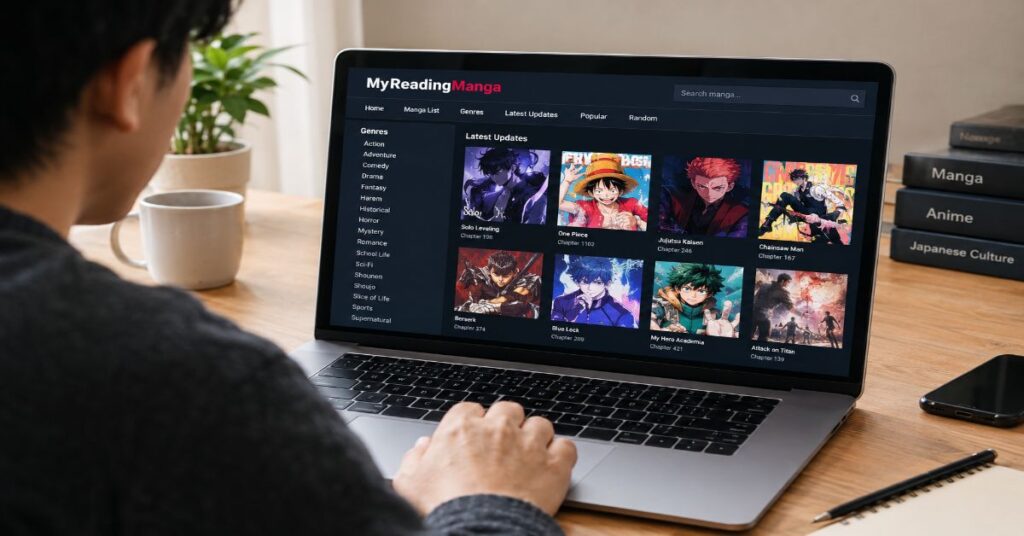
Search results consistently describe the site as an unofficial, user-driven archive rather than a conventional licensed publisher storefront. The recurring themes are fan-uploaded scans, translations, doujinshi, multilingual material, and a strong concentration of BL, yaoi, bara, and other LGBTQ+ comics. That pattern is useful for understanding search intent, but it is not the same as an operator-issued statement of ownership or licensing.
No reliable primary source from the platform operator was found establishing a current corporate identity, stable official domain, licensing program, or official app. Publishing a supposedly “official” address without verification could mislead readers, so this guide does not provide a working-domain list, mirror list, proxy path, or download route.
The safest factual description is narrower: the keyword points toward a web-based manga-sharing ecosystem associated with fan-translated or potentially unlicensed material and mature content. Judge any specific page by licensing evidence, privacy disclosures, download behavior, and local law.
The Biggest Problem With Most Guides: Certainty Without Verification
The top results are remarkably similar. They usually define the site, praise its large catalog and tag system, warn about ads, call the service illegal, list alternatives, and end with FAQs. That covers the obvious questions, but repetition has created a second problem: unsupported statements can become “common knowledge” simply because one site copied the framing of another.
A stronger answer separates platform-specific evidence from category-level risk. For example, an unofficial comic site can expose users to redirect ads, fake installers, or data collection, but that does not prove a particular page is currently serving malware. Likewise, domain instability is common in piracy ecosystems, but it should not be asserted as a documented history for one brand unless there is a source trail.
This evidence threshold is the main difference in this guide. Where the underlying fact cannot be independently established, it is labeled uncertain rather than upgraded into certainty for the sake of a stronger headline.
Claims That Need a Confidence Label
| Common SERP Claim | What This Review Could Verify | Assessment |
| “The current official domain is X” | No operator-verified current-domain notice found in this research. | Low unless a primary operator source is available |
| “The site definitely has malware” | No current independent technical audit of a verified operator domain was found. | Unverified platform-specific claim |
| “Every reader is breaking the law” | Copyright rules differ by jurisdiction and by conduct such as viewing, downloading, uploading, or redistribution. | Overbroad claim |
| “Manga Planet/futekiya is a current alternative” | Manga Planet announced and completed digital-platform closure on March 31, 2026. | Outdated |
| “Piracy enforcement is increasing” | Supported by 2026 CODA enforcement cases and international cooperation activity. | High |
Copyright Questions Need More Precision Than “Legal” or “Illegal”
Copyright law gives creators and other rights holders control over core acts such as reproduction and distribution. The U.S. Copyright Office lists the exclusive rights to reproduce a work, prepare derivative works, distribute copies, and publicly display certain works. That makes unauthorized scanning, uploading, and redistribution the clearest legal problem when copyrighted manga is shared without permission (U.S. Copyright Office, n.d.).
Reader conduct is more jurisdiction-specific. Japan provides a useful example of why broad statements are risky. Its 2020 copyright amendment, effective for the relevant download rules from January 1, 2021, expanded restrictions to knowingly downloading illegally uploaded works including manga, while also defining exceptions and narrowing criminal penalties to more serious repeated conduct involving works offered legitimately for a fee (Agency for Cultural Affairs, 2020).
That is more precise than saying every visit is automatically a crime everywhere. Merely opening a webpage, intentionally saving an infringing file, re-uploading a scan, and operating a large distribution site are different acts and can carry different legal consequences. For a broader explanation of how similar unauthorized-content services are evaluated, see our Bolly4u risk and alternatives guide.
Safety and Privacy: Separate Proven Risk From Fear-Based Claims
Many competitor pages say the site “has viruses” or can infect a device automatically. That language is stronger than the evidence found for this review. No current independent malware scan or technical audit of a verified MRM operator domain was identified, so this article does not label the site itself as malware.
The practical risk is still real at the category level. Unofficial content sites often rely on advertising, redirects, mirrors, and third-party scripts that users do not control. The safest response is behavioral: do not install an APK, browser extension, codec, or “reader” offered by a random page; do not enter payment-card details into a domain you cannot verify; deny unexpected notification prompts; keep the browser and operating system patched; and leave if a page repeatedly redirects or imitates a security warning.
A VPN is not a cure-all. It can change how network traffic is routed, but it does not turn an unlicensed copy into a licensed one, verify a domain, remove malicious scripts, or make a fake download safe. The same distinction between access and safety appears in our 1337x proxy safety guide.
Why the Demand Exists: The Licensing Gap Is Smaller, Not Gone
The continued search demand is not difficult to understand. Niche manga audiences have historically faced language gaps, regional licensing gaps, out-of-print titles, and slow official localization. Fan translation communities often grew in the space between what readers wanted and what publishers could economically license. That history helps explain demand, even though it does not grant permission to redistribute copyrighted work.
What has changed is the legal catalog. SuBLime continues to publish Boys’ Love manga in print and digital formats, including mature titles, with some digital volumes listed at $6.99. Seven Seas announced new BL licenses in 2026. Tappytoon, Lezhin Comics, and Tapas all maintain active BL catalogs with different licensing and payment models (SuBLime, 2026; Seven Seas Entertainment, 2026; Tappytoon, 2026; Lezhin Comics, 2026; Tapas, 2026).
There is also a warning here about stale advice. Manga Planet, which had absorbed the futekiya BL service into its digital ecosystem, announced in October 2025 that its digital platform would close at the end of March 2026. That closure happened on March 31, 2026 (Manga Planet, 2025). Any 2026 guide that still tells readers to subscribe to Manga Planet or futekiya as a current digital alternative is out of date.
Current Legal Alternatives: Which One Fits Which Reader?
No single licensed platform perfectly replaces the breadth that users associate with unofficial archives. The better question is what type of reader you are. A BL-focused reader, a mainstream Shueisha reader, and someone following indie webcomics need different services. The comparison below uses current official pages rather than inherited recommendations from older listicles.
| Platform | Best For | Payment Model | BL Fit | Strength | Trade-off |
| SuBLime | Licensed Japanese BL manga | Per-volume purchase; current digital examples around $6.99 | Strong | Focused BL catalog, print + digital | Not a subscription library; regional/store availability can vary |
| Lezhin Comics | BL webtoons and mature comics | Coin-based episode unlocks; prices vary by title and coin pack | Strong | Large active BL catalog, frequent releases | Episode costs can add up; catalog differs by region |
| Tappytoon | Licensed BL webcomics | Free/Time Till Free plus paid unlocks | Strong | Title pages identify licensing partners; large BL category | Primarily webcomics rather than Japanese print-manga backlists |
| Tapas | Indie and platform-published BL | Mix of free episodes and paid unlocks | Moderate to strong | Large creator ecosystem and active BL collections | Catalog style differs from scanlation-focused manga archives |
| MANGA Plus | Mainstream Shueisha manga | U.S. MAX plans shown at $1.99 and $4.99 monthly | Limited for BL specialists | Official global service with current chapters and large catalog | Not designed as a BL-focused replacement |
MANGA Plus states that it is an official Shueisha service and that proceeds support artists. Its current U.S. MAX plans are listed at $1.99 per month for Standard and $4.99 per month for Deluxe, with catalog exclusions and regional differences (MANGA Plus, 2026). SuBLime currently sells some digital BL volumes for $6.99, while Lezhin and Tappytoon use episode-unlock systems rather than a flat manga subscription.
A Practical Decision Rule Before Using Any Unofficial Manga Site
Instead of asking only whether a site is “safe,” ask five narrower questions. Can you identify the publisher or rights-holder relationship? Is there a real privacy policy and contact route? Does the page ask you to install software to read images? Does a payment request match the service identity? Can you find the title through a licensed publisher, library, or official app?
A page that fails several of those checks should not receive your credentials, card details, downloads, or device permissions. This is also why chasing a “new link” through social posts or random mirror directories is a poor solution when a familiar domain stops working. You cannot infer ownership from a logo, a copied layout, or a similar domain name.
For parents or shared devices, there is another issue: search results for this keyword can lead to mature material. Even when a page is not malicious, its content may be inappropriate for minors or for workplace and school devices. Licensed services usually make age ratings and account controls easier to understand.
Industry Impact Is Measurable, Not Abstract
The anti-piracy context became more concrete in 2026. CODA, using a survey commissioned by Japan’s Ministry of Economy, Trade and Industry and subcontracted to PwC Consulting, estimated 2025 losses from online piracy of Japan-origin digital content at 5.7 trillion yen. CODA said the estimate was roughly three times the comparable 2022 figure, with growth linked to exchange rates, prices, the number of piracy users, internet penetration, and the global popularity of Japanese content (CODA, 2026a).
A separate CODA case illustrates how large manga piracy networks can become without implying that the site operates at the same scale. CODA reported that the BATO.TO network included about 60 related sites, recorded roughly 350 million visits in May 2025, and reached about 7.2 billion visits across a 37-month period. After the network closed, NTT Solmare told CODA that daily sales at its U.S.-focused MangaPlaza store approximately doubled (CODA, 2026b).
Takero Goto, CODA’s representative director, called the BATO.TO closure “highly significant for cross-border anti-piracy efforts.” The useful takeaway is not that every unofficial manga site will disappear next. It is that rights enforcement is increasingly international, data-driven, and capable of affecting both traffic and licensed sales.
The Future of MyReadingManga in 2027
The most responsible forecast is about the environment around the keyword, not one domain. Cross-border enforcement is expanding: on September 1, 2026, CODA signed a new anti-piracy cooperation memorandum with U.S.-based IP House (CODA, 2026c). Licensed BL availability is also broadening, while Manga Planet’s closure shows that legal-service recommendations still need regular verification.
By 2027, search demand may shift toward verification: which domain is genuine, whether a title has an official release, and which active service carries it. That favors guides updated against publisher notices instead of recycled platform lists.
The uncertain part is the site itself. Without a verifiable operator statement, no responsible source can promise its domain status, uptime, ownership, or future availability. Readers should treat any confident 2027 prediction about a specific mirror as speculation unless it is backed by fresh evidence.
Key Takeaways
- The keyword is best understood as an unofficial manga-sharing search intent, not as a verified licensed storefront.
- Do not equate repeated blog claims with proof. Current malware, operator, domain-history, and app claims require direct evidence.
- Copyright exposure varies by act and jurisdiction; uploading, redistributing, and knowingly downloading can be treated differently.
- Manga Planet and futekiya should not appear on a list of active digital alternatives after Manga Planet closed on March 31, 2026.
- SuBLime, Lezhin, Tappytoon, Tapas, and MANGA Plus are active options, but each serves a different catalog and payment model.
- The strongest reader decision is to verify licensing, identity, privacy, and download behavior before trusting any unfamiliar manga site.
Conclusion
This keyword remains searchable because it sits at the intersection of niche demand, fan translation culture, mature BL discovery, and the long-running gap between global readers and official licensing. But a useful 2026 guide should not turn that popularity into false certainty. The most important finding is that many ranking pages confidently repeat claims that are difficult to verify, while some also recommend services that are no longer active. The better approach is evidence-based. Copyright owners hold clear rights over reproduction and distribution. Reader-side rules vary by country and by what the user actually does. Security warnings should focus on observable behavior, such as redirects, fake installers, credential requests, and unverified mirrors, rather than unsupported claims that a specific site is currently infected. And legal alternatives should be checked against current publisher pages before publication. If you want broader context on how we assess unofficial entertainment sites, our Movierulz 2026 risks and legal alternatives guide applies the same licensing-first method. The practical rule is simple: verify the service, verify the rights, and prefer active licensed sources when they carry the work you want.
Frequently Asked Questions
What does MRM refer to?
MRM is a search term commonly associated with a community-uploaded manga archive featuring fan translations, doujinshi, mature BL, yaoi, bara, and related comics. This review did not find a current operator-verified licensing statement, stable corporate identity, or official-domain notice, so it should not be described as a conventional licensed publisher platform.
Is the site safe in 2026?
There is not enough verified technical evidence to claim that a current domain using the brand name is either completely safe or definitively malware-infected. Treat unfamiliar mirrors, redirects, fake download buttons, APKs, browser-extension prompts, and payment requests as warning signs. Keep your browser updated and avoid giving sensitive information to a domain you cannot verify.
Is using the site legal?
The legal answer depends on the content, your country, and what you do. Copyright owners control reproduction and distribution, so unauthorized uploads and redistribution are clear risk areas. Some jurisdictions, including Japan, also regulate knowingly downloading illegally uploaded manga in specified circumstances. This article is general information, not legal advice.
Does My Reading Manga have an official app?
No operator-verified official app was found during this research. That means readers should be cautious with APK files or app listings that use the name. Do not assume an app is authentic because it copies a logo or brand name.
What are the best current legal alternatives for BL manga?
SuBLime is a strong option for licensed Japanese Boys’ Love volumes, while Lezhin Comics and Tappytoon have large BL webcomic catalogs. Tapas is useful for indie and platform-published BL comics. MANGA Plus is an official Shueisha service for mainstream manga, but it is not a BL specialist.
Why do older guides still recommend Manga Planet or futekiya?
Many search pages were written before the service change or were not updated afterward. Manga Planet announced that its digital service would close and ended the platform on March 31, 2026. That makes older “best alternatives” lists a useful reminder to verify current service status before publishing or subscribing.
Methodology
This review used a live September 10, 2026 search snapshot. Ten relevant article-style results were compared for intent, freshness, repeated claims, and evidence gaps. The outline was then built independently.
Primary sources were used for law, enforcement, platform status, licensing, pricing, and catalog availability. Competitor pages were used only to map the SERP and identify claims requiring verification.
AI disclosure for publication workflow: This article was drafted with AI assistance for review by the FilmyZilla2023 Editorial Team. Primary-source verification was used for legal, industry, platform, pricing, and closure claims. The editorial team should complete its own final fact check before publication.
References
Agency for Cultural Affairs, Government of Japan. (2020). Amendment to the Copyright Act approved by the Ordinary Session of the Diet in 2020. Agency for Cultural Affairs.
Content Overseas Distribution Association. (2026a). Survey on losses from online piracy of Japan-origin content in 2025. CODA.
Content Overseas Distribution Association. (2026b). Operator of the world’s largest manga piracy site BATO.TO criminally investigated in China. CODA.
Content Overseas Distribution Association. (2026c). CODA signs memorandum of understanding with U.S.-based investigation firm IP House. CODA.
Lezhin Comics. (2026). Business Performance: All-Ages Edition. Lezhin Comics.
Manga Planet. (2025). Closure of Manga Planet’s digital platform. Manga Planet.
MANGA Plus by SHUEISHA. (2026). Subscribe to MANGA Plus MAX. SHUEISHA.
Seven Seas Entertainment. (2026). Seven Seas licenses The Horizon Will Soon Shine Boys’ Love manga series. Seven Seas Entertainment.
SuBLime. (2026). SuBLime: Boys’ Love manga. SuBLime / VIZ Media.
Tappytoon. (2026). BL comics catalog. Tappytoon.
Tapas. (2026). BL comics collection. Tapas.
U.S. Copyright Office. (n.d.). What is copyright?. Library of Congress.