

Introduction
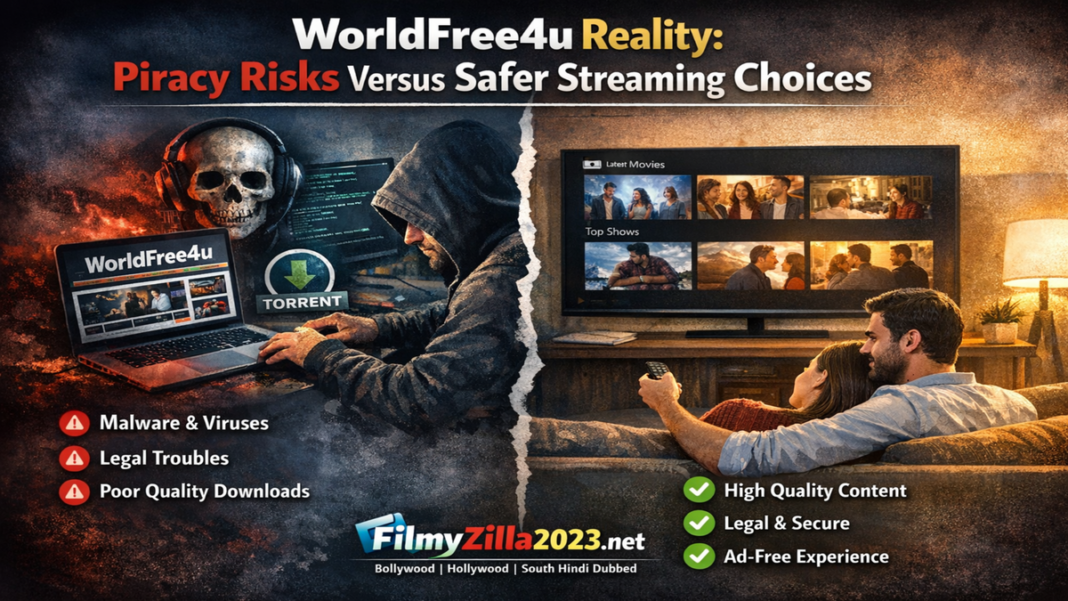
When people search worldfree4u, they are usually trying to compress the time between theatrical release and home viewing, without paying for the official window. From an industry standpoint, that demand collides with three realities in Pakistan: routine access disruption from large-scale URL blocking, statutory copyright penalties that include prison terms and fines, and a high malware exposure profile for piracy sites. In January 2026, Pakistan Telecommunication Authority reporting to the Lahore High Court described blocking on a large scale, reinforcing why users experience frequent domain failures and constant mirror churn.
I have tracked how piracy brands behave across domain rotations and how streaming platforms respond with release windowing, pricing, and enforcement partnerships. The pattern is consistent. Piracy sites do not aim for service stability, they optimize for traffic spikes and ad conversions before the next shutdown. That business model creates predictable user outcomes: unreliable access, aggressive redirects, and higher security risk than legal services.
This article stays industry-focused. It explains how the piracy portal model works, why Pakistan-based users face compounding risk, and what legal streaming alternatives offer in measurable terms like offline viewing, predictable quality, and accountable billing. It is not a moral argument, it is a cost and risk argument grounded in documented enforcement and cybersecurity research.
The WorldFree4u Model Is an Arbitrage, Not a Platform
A legal streaming service invests in uptime, customer support, content delivery infrastructure, and license compliance because it needs long-term retention. A piracy portal does the opposite. Its economic incentive is short-term monetization, usually via ad networks, redirects, and affiliate installs, with minimal fixed costs.
That incentive structure explains why piracy portals feel volatile. Domain hopping is not a technical accident, it is operational risk management. When a domain is blocked or seized, operators move to a new one and rely on search demand to follow. The brand persists, the “product” resets.
I have reviewed takedown reporting patterns and the cadence of mirror reappearance across multiple piracy ecosystems. The key insight is simple. If stability increases legal exposure, instability becomes the business strategy.
Pakistan’s Access Friction Is Now Part of the User Experience
Pakistan’s telecom enforcement posture matters because it raises friction even when it does not eliminate access completely. In January 2026, PTA reporting referenced blocking more than one million links and URLs as part of actions against unlawful online content. While those figures are not exclusively about copyright, the practical effect is familiar to viewers: websites disappear, proxies appear, and availability becomes inconsistent.
For film and streaming markets, friction changes consumption. It pushes viewers toward services that work reliably on the first attempt, especially when bandwidth is constrained or connectivity is uneven. That is also why legitimate services emphasize offline downloads and adaptive streaming, they compete against inconvenience as much as price.
From a studio perspective, enforcement is not only about punishment. It is also about increasing the cost of piracy in time, reliability, and risk, so that legal services become the rational default.
Legal Exposure Exists, Even If Enforcement Is Uneven
Pakistan’s Copyright Ordinance includes criminal penalties that can reach imprisonment up to three years and fines, depending on the offense and proceeding. This is not a prediction about any individual case, but it is the statutory baseline that shapes risk.
The broader industry point is asymmetric downside. A user saves a small monthly amount by avoiding subscriptions, but the legal downside, if it materializes, is far larger than the savings. That asymmetry is one reason studios and anti-piracy coalitions keep investing in enforcement and court processes. Even modest enforcement visibility can shift behavior at scale.
This is also why “current working domain” narratives are structurally unreliable. A piracy brand that depends on evasion is not a stable service, and stability is exactly what consumers typically want.
Cybersecurity Risk Is a Core Cost of Piracy Consumption
Cyber risk is not a side issue, it is one of the primary hidden costs that piracy shifts onto households. A 2025 ACE-commissioned study reported that, in the worst case measured, consumers could be up to 65 times more likely to encounter malware when using piracy sites versus legitimate websites.
A separate analysis highlighted by the Audiovisual Anti-Piracy Alliance described malware distribution techniques tied to piracy consumption, including malicious advertising and notification hijacking, and reported a high probability of embedded malware in piracy apps within its examined sample.
Expert quote 1: Charles Rivkin of the Motion Picture Association warned that piracy sites can draw “millions of unsuspecting viewers whose personal data can then fall prey to malware and hackers.”
The mechanism is straightforward. Piracy portals often monetize through ad ecosystems that legitimate platforms would block, and users face the security consequences.
Why Shutdowns and Mirror Churn Keep Repeating
Global enforcement has become more coordinated, particularly through coalitions like the Alliance for Creativity and Entertainment. Coverage of major takedowns shows a pattern of collaboration, targeted operations, and repeated shutdowns of prominent piracy networks.
From a market perspective, this produces a predictable cycle. When a piracy site grows large enough to be worth targeting, it becomes more visible to enforcement and rights-holders. Operators respond by fragmenting into mirrors and proxies, which reduces stability and increases the reliance on aggressive advertising.
Expert quote 2: Rivkin described a major takedown as “a stunning victory for casts, crews, writers, directors, studios, and the creative community.”
For legal platforms, this turbulence is useful. Every interruption is a chance to convert a frustrated viewer into a subscriber, especially when the legal offer includes offline viewing and consistent quality.
The Real Comparison Is Reliability, Not Price Alone
Viewers often compare piracy to subscription fees as if price is the only variable. In practice, reliability and total time cost matter. If a site fails, the user spends time searching mirrors, reloading pages, and troubleshooting playback. That time has an economic value, even if it is not billed.
I have compared household viewing patterns across services, and the adoption trigger is usually a reliability moment. One too many failed attempts, one compromised device, or one account takeover incident, and the household recalculates.
Below is a structured view of what changes when consumption moves from piracy portals to legal services.
| Dimension | Piracy portal pattern | Legal platform pattern |
|---|---|---|
| Availability | Domain churn, frequent outages | Stable apps and catalog pages |
| Security | Higher exposure to malicious ads and redirects | Curated app environments, account controls |
| Quality control | Inconsistent encodes, watermarks | Predictable resolutions, audio tracks |
| Accountability | No customer support, no dispute path | Billing records, support channels |
The point is not that legal is perfect. The point is that legal is measurable and accountable.
Legal Streaming Alternatives in Pakistan That Match Dubbed Demand
For viewers who prioritize Hindi and South Indian dubbed films, the most practical competitors are mainstream services with offline downloads. Netflix markets availability in Pakistan through its official site, and major platforms continue to compete on catalog breadth and playback reliability.
Rather than exaggerating title availability, which changes by license window, the best decision frame is feature fit: offline, stable playback, and predictable monthly cost.
| Service | What it tends to do well | Why it matters in Pakistan |
|---|---|---|
| Netflix | Strong dubbed catalog depth, downloads | Offline viewing reduces buffering risk |
| Prime Video | Frequent studio deals, varied library | Price-to-library ratio can be favorable |
| YouTube Premium | Official channels, offline for permitted content | Cleaner viewing and reduced ad risk |
This is where the industry strategy becomes visible. Legal services win when they deliver consistent access faster than piracy delivers “free.”
What Film and Streaming Companies Learn From Piracy Demand
Piracy demand is information. It tells the industry where availability, pricing, or timing is misaligned with audience willingness to pay. Studios respond in a few predictable ways: tighter security and watermarking, more aggressive enforcement, and more competitive release windows on streaming.
None of that guarantees a viewer gets every title quickly. Fragmentation across platforms remains a real friction, and it is one reason piracy still exists. But the market has a clear trajectory. Platforms are investing in convenience features that directly neutralize piracy’s advantages, including downloads, adaptive streaming, and localized payment options.
Expert quote 3: The ACE-commissioned research concluded piracy users face “severe risk of cyber threats” from criminal actors exploiting unlicensed platforms.
In practice, the most durable anti-piracy strategy is not only enforcement. It is making legal viewing feel simpler than the illegal path.
Takeaways
- Piracy portals optimize for short-term traffic, so instability is structural, not accidental.
- PTA-scale blocking raises friction and contributes to frequent access disruption.
- Pakistan’s copyright framework includes criminal penalties that create asymmetric downside.
- Independent research links piracy consumption to materially higher malware exposure.
- Legal streaming competes on reliability, offline viewing, and accountable quality.
- The industry increasingly treats piracy as both an enforcement issue and a product design problem.
Conclusion
worldfree4u is best understood as a symptom of distribution pressure, not as a dependable viewing option. The portal model depends on evasion, which produces the very instability users complain about, shifting costs into time, security exposure, and uncertainty. Pakistan’s large-scale blocking environment adds friction that makes this instability more visible, more frequent, and more frustrating.
For viewers, the rational comparison is risk-adjusted cost. Legal services compress uncertainty into a predictable monthly payment and reduce exposure to malware-heavy advertising flows documented in multiple studies. From an industry standpoint, the trajectory is steady rather than dramatic. Enforcement coordination continues, cybersecurity risks are better measured, and platforms compete by improving the convenience features that matter most in real households, especially offline viewing and stable playback. The cleanest outcome for audiences is also the most sustainable one for the industry: reliable access that does not externalize risk onto the viewer.
Read: Super singer vote: How Season 11 finale voting works
FAQs
Is worldfree4u legal in Pakistan?
No. Sites distributing unauthorized copies of films do not operate within legal licensing frameworks. Pakistan’s copyright law provides for criminal penalties and fines for infringement.
Why do domains and proxies change so often?
Frequent changes reduce exposure to blocking and takedown actions. It is operational continuity for illicit operators, not evidence of legitimacy or stability.
Are piracy sites really associated with malware?
Yes. Research commissioned by ACE reported substantially higher malware risk on piracy sites compared with legitimate services.
Does PTA blocking mean the site is permanently removed?
Blocking reduces access for many users but does not necessarily remove a service globally. It does increase friction and lowers reliability over time.
What is the safest way to watch with inconsistent internet?
Legal services that support offline downloads and stable apps generally provide the best reliability and lowest security risk relative to piracy portals.
References
Alliance for Creativity and Entertainment. (2025, July 23). Study finds consumers up to 65 times more likely to be infected with malware when using piracy sites. PR Newswire. https://www.prnewswire.com/apac/news-releases/study-finds-consumers-up-to-65-times-more-likely-to-be-infected-with-malware-when-using-piracy-sites-302511509.html

Pakistan Telecommunication Authority reporting (as covered by press). (2026, January 17). Illegal content: PTA blocks 1m sites. The Express Tribune. https://tribune.com.pk/story/2587593/illegal-content-pta-blocks-1m-sites

Roth, E. (2024, August 29). Studios are cracking down on some of the internet’s most popular pirating sites. The Verge. https://www.theverge.com/2024/8/29/24231552/fmovies-aniwave-alliance-for-creativity-and-entertainment-piracy

Rivkin, C. (2024, April 9). Charles Rivkin “State of the Industry” address at CinemaCon 2024. Motion Picture Association. https://www.motionpictures.org/remarks/charles-rivkin-state-of-the-industry-address-at-cinemacon-2024/

Audiovisual Anti-Piracy Alliance. (2022, September 19). Study on malware and audiovisual piracy highlights significant risks to European consumers. https://www.aapa.eu/study-on-malware-and-audiovisual-piracy-highlights-significant-risks-to-european-consumers

Government of Pakistan. (1962). Copyright Ordinance, 1962. Pakistan Code. https://pakistancode.gov.pk/english/UY2FqaJw1-apaUY2Fqa-apaUY2Npa5pibA%3D%3D-sg-jjjjjjjjjjjjj

Lexology. (2021, May 27). In brief: copyright infringement and remedies in Pakistan. https://www.lexology.com/library/detail.aspx?g=9e125b3e-0747-4734-b106-fc9f6458213c